Turn On Your Future @ UWTSD's School of Applied Computing & Electronics

Posts tagged ‘Swansea’

Graduate Profile: Richard Evans @ University of Greenwich

Richard

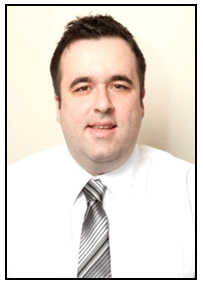
Richard Evans studied the MSc e-Commerce (Business pathway) at the School of Applied Computing UWTSD Swansea. He is now a Research Fellow @ the University of Greenwich, to learn more about Richard’s Career success please continuing reading below.

What was your HE course at the School of Applied Computing?

 MSc in e-Commerce (Business).

 What is your job title and role?

 Research Fellow in Knowledge Management for Collaborative Product Development at the University of Greenwich

My role within the University of Greenwich is to conduct research into the use of Web 2.0 technologies to improve employee collaboration and knowledge sharing during product development lifecycles in extended supply chains. I am currently working in collaboration with CESi University, Rouen, France as part of a European INTERREG research project.

My responsibilities include: liaising and maintaining links with industrial collaborators, organising bi-annual industrial workshops, identifying potential funding opportunities and assisting with grant applications. I review articles for the International Journal of Modelling, Identification and Control and the International Conference on Teaching, Assessment and Learning for Engineering and am currently a member of the Host Organising Committee for the International Conference on Computer Aided Design and Applications Conference, which is being held at the University of Greenwich in 2015. Finally, I teach and assess two MSc modules within the Faculty of Engineering and Science: Research Methodologies and e-Technologies. I am also a Visiting Lecturer at Cranfield University where I teach lectures to MSc students on the use of Web 2.0 Technologies in Business.

 Could you briefly describe the organization you work for?

The University of Greenwich is a British University with over 27,000 students and offers HE courses, including undergraduate and postgraduate degree programmes. The university has three main campuses situated in the South East of England. I currently work in the Centre of Innovative Product Development and Manufacturing (CiPDM) which sits within the Faculty of Engineering and Science.

The CiPDM carries out strategic research and consultancy in the manufacturing sector in areas such as new product development; collaboration between Original Equipment Manufacturers (OEMs) and their suppliers; digital and sustainable manufacturing; information and knowledge management; and product lifecycle management. The centre focuses on new enabling technologies and methods and processes for the design, manufacturing and servicing of high value complex engineering products and systems in the aerospace, automotive, power generation and general manufacturing sector. The centre employs six members of academic staff, including myself, and we currently have six full-time PhD students who work in collaboration with our industrial partners who include BAE Systems, Cummins Power Generation and Ford Motor Company.

 A brief summary of your Career, how you got to where you are today?

After finishing my MSc degree in e-Commerce, I immediately got offered the role of Online Product Manager for Dunelm Mill Ltd, the UK’s largest home furnishings organisation. I stayed in the role for 8 months before seeking funded PhD programmes; this led me to the position at BAE Systems, which I started in October 2010. During my PhD, I worked for BAE Systems’ Electronic Systems division in Rochester, Kent. I also became a professional member of both the Institution of Engineering and Technology (IET) and the British Computer Society (BCS). I successfully defended my PhD in August 2013 and was then offered a full-time role at the University of Greenwich as a research fellow in knowledge management for collaborative product development.

 Which skills learned at University are helpful to you in your job?

Good question! In my own experience, the knowledge I acquired in web programming has helped a lot during my PhD where I had to create a bespoke IT system. When working for Dunelm Mill, my knowledge of e-Commerce Law really helped – I think this is only available on the business route.

 Do you have a typical day and how would you describe it?

A typical day can take one of two routes:

  1. During term time, I would teach two lectures per week, meet with MSc students for supervision meetings, assess coursework submissions and conduct research, including reading academic publications, writing articles for submission. I also typically present at two international conferences per year within the fields of manufacturing and information systems.
  2. During non-term time, I spend all day conducting research – reading through publications and formilising my own ideas for new projects and publications. I would also assist the Centre manager in research grant applications and management.

What aspects of your job do you enjoy most?

Two aspects stand out: liaising with industrial collaborators – seeing your research being transferred into a commercial setting gives you a real “buzz” and also attending conferences and networking events – not only do you get to travel the world, but you get to meet new people from other Universities who may turn into collaborators on future projects.

 Do you have any advice for students who would like to start a Career in the IT industry? 

  • Do not underestimate your own knowledge and skills – you will find when you join a large organisation that you are more than capable with the knowledge which you have acquired at University.
  • Become a member of a professional association e.g. British Computer Society (BCS). Attend their networking events and gain knowledge about the current needs and challenges in the IT industry.
  • Gain greater knowledge of the current systems used within the IT industry e.g. in my role at Dunelm Mill, we used IBM WebSphere Commerce and Google Analytics for e-Commerce tasks. Having worked for BAE Systems, I found that Microsoft Sharepoint and Yammer is relied upon for employee collaboration whilst PTC WindChill and other PLM tools are used for manufacturing work.

Applied Computing Newsletter 2014

Each year we publish some of the School’s latest activities including inspiring staff student and industry news. We hope you enjoy the publication : ) Please click the link below to view the School’s 2014 Newsletter:nl2014

If you would like to contribute please e-mail: james.williams@sm.uwtsd.ac.uk.

Image

CONGRATULATIONS GRADUATES OF 2014

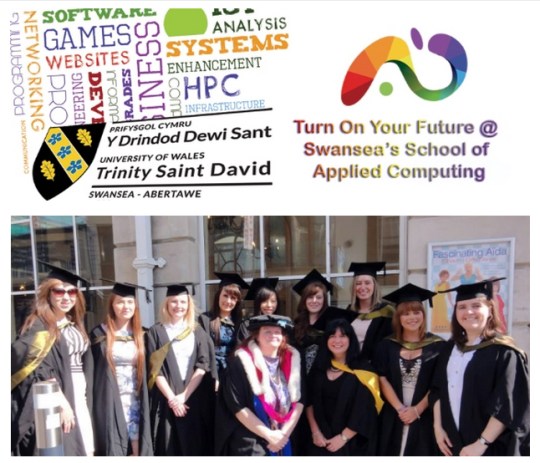
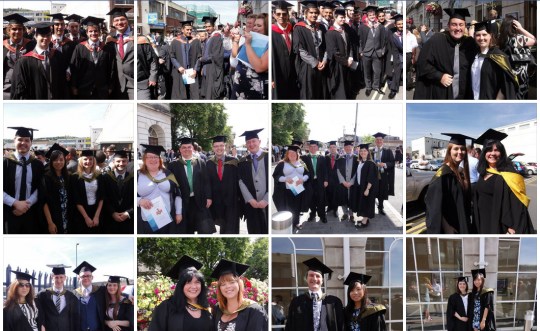
 Some of our Graduating students at Swansea’s Grand Theatre Graduation Ceremony. Well done & Congratulations to you all! 🙂

Please click below for more photos 🙂

Graduation2014

Computing & Technology – to infinity and Beyond

buzz-lightyear-toy-story-murals

Technology has and is revolutionising the way we live and work – but believe it or not, it’s just getting started. Technology is getting better and better and in the future – the possibilities are infinite.

Technology is a very exciting area. As new technology emerges and evolves it continues to enrich and enhance our lives, such as:

  • Helping us to share and  communicate with family friends or work colleagues;
  • Empowering us to bring our ideas to life and create in an infinite number of ways;
  • Entertain ourselves with music movies games or various social-media platforms.

Computers operated by the mind motion and emotion, wearable technology, environmental technology and advanced medical treatments are among the emerging technologies that will enhance our lives and reshape the future. Some recent developments include:

  • The internet of things in which the physical objects around us are connected to the web will make our environment more interactive including such things as Smart Homes Cars, Offices, Cafes, Public and Community Spaces.
  • Google Glass that allow us to live in an Augmented Reality, being able to view social media feeds, text, play games, navigate with Google Maps, take photos etc… other tech companies are bound to innovate and create different versions with increasing features and possibilities soon.
  • Virtual Reality gaming is here in the form of Oculus Rift – this 3D headset lets you feel that you are actually inside a video game. This is the beginning of the revolution for next-generation gaming.
  • 3D printing technology allows us to print our design ideas into a solid real-life product.
  • Wearable Computing, recent developments include gadgets with flexible displays, making it possible to wrap a handset around your wrist, turning it into a bracelet that plays your favourite music or displays Social Media updates. Many forecast that flexible electronics will give rise to smart fabrics, making clothing items with built-in music-players, changeable colours and patterns, or heaters (for the colder months) a reality.
  • Robotics will see intelligent machines or robots expand beyond manufacturing and enter our lives to assist our working and personal lives. Maybe someday soon, your new robot friend will help you to complete tasks, will help around the house and help you make a delicious meal.

Advances in electronics and nanotechnology will continue to make computers ever smaller, slimmer and multi-functional. Increasing Philanthropic initiatives coupled with low-cost Smartphone’s tablets and communication methods will continue to reach developing parts of the world, providing hard-to-reach community’s access to the Global Connected Community.

The World Economic Forum has compiled a list of the most potentially influential technologies currently being developed. Each innovation was selected for its capacity to have a real and positive impact on the world, according to the WEF’s Global Agenda Council on Emerging Technologies topping the list is “brain-computer interfaces” which would build on the already available technology which allows people to type by monitoring their electrical activity in their brain. The technology could make it possible for people with disabilities to operate wheelchairs and other equipment using their thoughts. In its report the council stated:

Technology has become perhaps the greatest agent of change in the modern world. While never without risk, positive technological breakthroughs promise innovative solutions to the most pressing global challenges of our time.

The council wants to see governments working with researchers and businesses to promote the emerging technologies which could bring great improvements to many people’s lives. Martina Larkin, senior director and head of the Network of Global Agenda Councils, said: “Close cooperation between governments, industry and academia is essential to harness their potential.” And Noubar Afeyan, chair of the Global Agenda Council on Emerging Technologies and CEO of Flagship Ventures, said:

“These breakthroughs show the boundless potential for technology to have a positive impact on society.”

Arabian feast 2014

Final Year Degree Students from Saudi Arabia Studying at Swansea’s School of Applied Computing Surprise the Teaching Team with an Arabian feast fit for a King. An offering of thanks for the support they have received during their time at the University. The Team are Very Grateful and would like to thank all those involved in preparing cooking and organising the delicious meal. THANK YOU VERY MUCH x.

Arabian feast

Graduate Profile: Aisha Iftikhar

Aisha-brdQ. What was your HE course?

BSc (Hons) Business Information Technology

Q. What is your job title and role?

Multiple business owner: My role is to lead businesses, as an MD Managing Director at Costcutters supermarket and as a Principal at Swansea sixth form College. This involves many different areas including leadership, teacher evaluation, student discipline, staff discipline, accounting and several others.

Q. Could you briefly describe the organization you work for?

Swansea Sixth-form College (SSC) offer a wide range of practical English language courses. SSC offer high quality teaching with flexible study options, in a beautiful environment designed to develop our students confidence and increase motivation. Whether your goal is to improve your job prospects, get a place at university, pass an English language exam, live and work abroad, improve your English for business purposes, adapt to life in the UK or travel and see the world, we have a course to suit you.

Q. Which skills learned at University are helpful to you in your job?

My 3 years at Swansea Met were life changing. The environment excelled my development as a student. The skills that I developed while studying have had a positive influence on my role, personally, my involvement in the community and professionally. Commitment, self-motivation and confidence, all of which are highly valued skills which I gained from my course have helped me in my role as a Principal.

The following two skills which have been vital for my role, which I gained in my course through research, planning and assignments:
1. Knowledge and understanding – Gaining specific knowledge related to a particular subject, for example historical or scientific data
2. Cognitive skills – Thinking skills, such as problem solving, analysis, research.

Q. Do you have a typical day and how would you describe it?

My typical day, as much I would like to say planned and calm, it is as hectic and sometimes unpredictable. There are no two days the same. I still feel I am learning something new everyday. My day can range from staff meetings, student inductions, class monitoring, teaching assessments and auditing. We also take pride in our diverse culture and at the same time our city, and reach out exertions and show off our heritage.

Q. What aspects of your job do you enjoy most?

My job role highly motivates me, I do enjoy all aspects of my job.
It’s a huge responsibility being part of such a successful college and to be responsible for so many different people. I love learning and meeting people.

Q. Do you have any advice for students who would like to start a Career?

Your whole life is a learning curve, the biggest challenge is in within yourself. Always take issues/problems as a challenge, remove all barriers.
Set high goals, you should never be able to accomplish your goal, you should get nearer and nearer each time. If you think you have reached it, then you haven’t set a high enough goal, the sky is the limit.

Commitment, reliability, humbleness and honesty to yourself and your job is your key ingredient for success.

Image

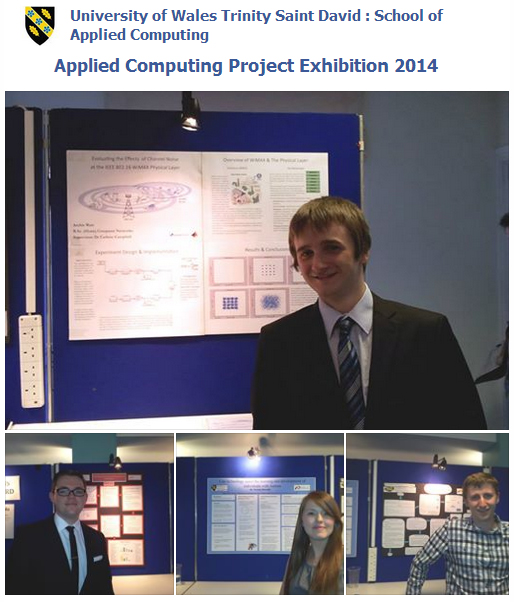
Applied Computing Project Exhibition 2014

blog-cover

Deborah Roberts: Web Developer @ DAC

29dd4d8What was your HE course?
The course that I did was BSc (Hons) Web Development.

What is your job title and role?
My job title is web developer/technical auditor at the Digital Accessibility Centre (DAC). My role varies to include design and development of small SME websites, Mobile Apps, technical auditing, accessibility testing and reporting on larger websites including clients such as Channel 4, Money Advice Service, HMRC, Lloyds, Santander and many more.

Could you briefly describe the organization you work for?
The organisation I work for deals with the accessibility testing of digital products to WCAG 2.0 standards. We have a team of expert testers that have a range of disabilities and use various Assistive technologies to ensure that these products are accessible and inclusive to all.

Which skills learned at University are helpful to you in your job?
The skills that I learnt at University that I have found help me are web design and development skills, report writing, how to research and meet deadlines and the final project that I undertook relating to accessibility and accessibility guidelines.

Do you have a typical day and how would you describe it?
I can be involved in any part or all of the process depending on how many audits are on-going. I could be working with the testers where I analyse code as they find accessibility issues with a website or mobile app in relation to their assistive technologies. I will then find the reason for the problem and offer companies a solution for fixing it.

I will then complete a technical audit and compile a report. This process is then followed up with a conference call with project managers and developers/designers to discuss a way forward for compliance.

I have also been involved in training developers, designers and project managers in creating accessible products, selling the service to clients and presentations.

A colleague and I also developed the Accessibility ‘hub’ for Virgin Media’s website.

What aspects of your job do you enjoy most?
I do enjoy getting out of the office and visiting companies all over the UK and seeing how they work. I have recently been to HMRC offices after being involved in a piece of work for them, along with Channel 4, ITV and Virgin. But the part that I like is the analysing of code, finding the reason why a screen reader for example is not working with the code and finding a way of fixing it. It is also nice to see the fixes that I have suggested being implemented and no longer causing my blind colleagues an issue.

Do you have any advice for students who would like to start a Career?
Yes, work hard and stay focussed, if you’re determined you’ll get there.

IT and Business Development jobs

jobsites

IT and Business Development jobs in Swansea Caerphilly Cardiff and London:

Industry Guest Speakers: Grant Armstrong & Sion Williams

Two of our Graduates Grant Armstrong and Sion Williams return to the School on Friday to talk about their Careers to date including how they got their first jobs which will be very useful for our current students.

  1. At 11am Grant Armstrong will be talking about his experiences as a software developer working for both Acentic (Hotel TV and hospitality technology) and Aria Networks (Network capacity management software).
  1. At 3pm Sion Williams will be talking about his work as a build and release engineer working at both the Office of National Statistics and Liverpool Victoria.

The talks will include some biographical material about how the students got their first jobs and also included will be information about interesting/upcoming technologies they thing graduates should be aware of and tips for those entering the industry.

If you are interested please feel free to come along to the School of Applied Computing this Friday 28th February at 11am, room MH303, Mount Pleasant Campus, Swansea.

HOMEPAGE1Acentic are global leaders in hotel TV and hospitality technology, operating in more than 40 countries. Acentic is an  integrator of technologies that connect, engage and entertain. Acentic’s range of products include Acentic Smart – future ready Smart TV solution,  Acentic Media advertising, hotel mobile applications, digital interactive television (iTV) and high definition TV platforms (HD TV).

Aria_Networks_company_logoAria’s core technology is called DANI (Distributed Artificial Neural Intelligence) which is a self-learning and evolutionary modelling software suite that can automatically build and execute algorithms on a distributed computing architecture. Aria Networks provides set of solutions to service providers such as capacity planning and management to help service providers achieving the maximum utilisation of their networks.LV_Liverpool_VictoriaLV= Liverpool Victoria serves over five million customers with a wide range of financial services including car, home and life insurance plus investment and retirement products. LV= is also is the UK’s largest friendly society.

Office_for_National_Statistics_logo
The Office for National Statistics (ONS) is the executive office of the UK Statistics Authority, a non-ministerial department which reports directly to the Parliament of the United Kingdom. It is charged with the collection and publication of statistics related to the economy, population and society of England and Wales at national, regional and local levels.