Turn On Your Future @ UWTSD's School of Applied Computing & Electronics

Author Archive

NEWS: Glass and HUDs

man-google-glass

A recent article by the BCS -The Chartered Institute for IT investigating Google Glass and Heads-Up Display (HUD) Technology states that “by 2020 there could be heads-up displays (HUDs) in over nine million cars. Brian Runciman MBCS looks at some of the impacts of HUDs and Google Glass.

Five years ago only 13 models of car produced in the USA had heads-up displays as standard or an option – that figure now stands at 38. Google Glass is seeping into business life: service technicians use them, they are being used in broadcasting, airlines are trialling them – they are even getting onto farms.

In car HUDs have increased in processing power to allow for more information to reside in a driver’s line of sight. Whilst this has until recently been in marquee cars, as costs come down they will be designed for small and mid-sized cars. By 2020, one forecast suggests, HUDs will be designed into 9.2 million cars, compared with 1.2 million in 2012.”

To read the full article please click-here.

Graduate Profile: Neil Page – Online Manager @ Cruise Nation

neil2

What was your HE course? I completed the BSc degree in Web Development at the School of Applied Computing.

What is your job title and role?
My current job title is Online Manager. This means that I’m responsible for my companies online presence. This encompasses a multitude of different activities, but I mainly oversee our e-mail marketing activities, design and maintenance of the company website as well as all online advertising. I’m also required to manage several third-parties to ensure we achieve all of our Organic Search and PR goals.

Could you briefly describe the organization you work for?
I work for Cruise Nation. We’re a Cruise Tour Operator, meaning we put together our own cruise holiday packages to sell across the UK. In the last 2 years we’ve grown from 8 employees to 25, and won numerous awards in the industry.

Which skills learned at University are helpful to you in your job?
I use HTML, CSS and javascript/jQuery on a daily basis! I picked up these in University. I also use Photoshop and Illustrator on a regular basis. I think the main thing I picked up in university was an understanding on a breadth of different subjects, and a deeper knowledge.

What aspects of your job do you enjoy most? I love the challenge of working with a smaller team, and seeing the results that my input can generate. I enjoy the level of responsibility that my role involves.  I’ve always been pretty addicted to all things web-related, so to be able to work within this industry every day is very really satisfying.

Do you have any advice for students who would like to start a Career? Studying a higher education course at University will give you the perfect base to start a career of your choice. I’d always recommend that you do as much work as possible in your own time, so you fully understand the lectures and classes that are given to you. During the Summer Holidays, be on the lookout for any work experience you can get, this will really help in you get your foot in the door after you graduate, and you’ll find you’ll learn so much more when you’re working day-to-day.

Graduate Profile: Richard Evans @ University of Greenwich

Richard

Richard Evans studied the MSc e-Commerce (Business pathway) at the School of Applied Computing UWTSD Swansea. He is now a Research Fellow @ the University of Greenwich, to learn more about Richard’s Career success please continuing reading below.

What was your HE course at the School of Applied Computing?

 MSc in e-Commerce (Business).

 What is your job title and role?

 Research Fellow in Knowledge Management for Collaborative Product Development at the University of Greenwich

My role within the University of Greenwich is to conduct research into the use of Web 2.0 technologies to improve employee collaboration and knowledge sharing during product development lifecycles in extended supply chains. I am currently working in collaboration with CESi University, Rouen, France as part of a European INTERREG research project.

My responsibilities include: liaising and maintaining links with industrial collaborators, organising bi-annual industrial workshops, identifying potential funding opportunities and assisting with grant applications. I review articles for the International Journal of Modelling, Identification and Control and the International Conference on Teaching, Assessment and Learning for Engineering and am currently a member of the Host Organising Committee for the International Conference on Computer Aided Design and Applications Conference, which is being held at the University of Greenwich in 2015. Finally, I teach and assess two MSc modules within the Faculty of Engineering and Science: Research Methodologies and e-Technologies. I am also a Visiting Lecturer at Cranfield University where I teach lectures to MSc students on the use of Web 2.0 Technologies in Business.

 Could you briefly describe the organization you work for?

The University of Greenwich is a British University with over 27,000 students and offers HE courses, including undergraduate and postgraduate degree programmes. The university has three main campuses situated in the South East of England. I currently work in the Centre of Innovative Product Development and Manufacturing (CiPDM) which sits within the Faculty of Engineering and Science.

The CiPDM carries out strategic research and consultancy in the manufacturing sector in areas such as new product development; collaboration between Original Equipment Manufacturers (OEMs) and their suppliers; digital and sustainable manufacturing; information and knowledge management; and product lifecycle management. The centre focuses on new enabling technologies and methods and processes for the design, manufacturing and servicing of high value complex engineering products and systems in the aerospace, automotive, power generation and general manufacturing sector. The centre employs six members of academic staff, including myself, and we currently have six full-time PhD students who work in collaboration with our industrial partners who include BAE Systems, Cummins Power Generation and Ford Motor Company.

 A brief summary of your Career, how you got to where you are today?

After finishing my MSc degree in e-Commerce, I immediately got offered the role of Online Product Manager for Dunelm Mill Ltd, the UK’s largest home furnishings organisation. I stayed in the role for 8 months before seeking funded PhD programmes; this led me to the position at BAE Systems, which I started in October 2010. During my PhD, I worked for BAE Systems’ Electronic Systems division in Rochester, Kent. I also became a professional member of both the Institution of Engineering and Technology (IET) and the British Computer Society (BCS). I successfully defended my PhD in August 2013 and was then offered a full-time role at the University of Greenwich as a research fellow in knowledge management for collaborative product development.

 Which skills learned at University are helpful to you in your job?

Good question! In my own experience, the knowledge I acquired in web programming has helped a lot during my PhD where I had to create a bespoke IT system. When working for Dunelm Mill, my knowledge of e-Commerce Law really helped – I think this is only available on the business route.

 Do you have a typical day and how would you describe it?

A typical day can take one of two routes:

  1. During term time, I would teach two lectures per week, meet with MSc students for supervision meetings, assess coursework submissions and conduct research, including reading academic publications, writing articles for submission. I also typically present at two international conferences per year within the fields of manufacturing and information systems.
  2. During non-term time, I spend all day conducting research – reading through publications and formilising my own ideas for new projects and publications. I would also assist the Centre manager in research grant applications and management.

What aspects of your job do you enjoy most?

Two aspects stand out: liaising with industrial collaborators – seeing your research being transferred into a commercial setting gives you a real “buzz” and also attending conferences and networking events – not only do you get to travel the world, but you get to meet new people from other Universities who may turn into collaborators on future projects.

 Do you have any advice for students who would like to start a Career in the IT industry? 

  • Do not underestimate your own knowledge and skills – you will find when you join a large organisation that you are more than capable with the knowledge which you have acquired at University.
  • Become a member of a professional association e.g. British Computer Society (BCS). Attend their networking events and gain knowledge about the current needs and challenges in the IT industry.
  • Gain greater knowledge of the current systems used within the IT industry e.g. in my role at Dunelm Mill, we used IBM WebSphere Commerce and Google Analytics for e-Commerce tasks. Having worked for BAE Systems, I found that Microsoft Sharepoint and Yammer is relied upon for employee collaboration whilst PTC WindChill and other PLM tools are used for manufacturing work.


Arabian feast 2014

Final Year Degree Students from Saudi Arabia Studying at Swansea’s School of Applied Computing Surprise the Teaching Team with an Arabian feast fit for a King. An offering of thanks for the support they have received during their time at the University. The Team are Very Grateful and would like to thank all those involved in preparing cooking and organising the delicious meal. THANK YOU VERY MUCH x.

Arabian feast

Image

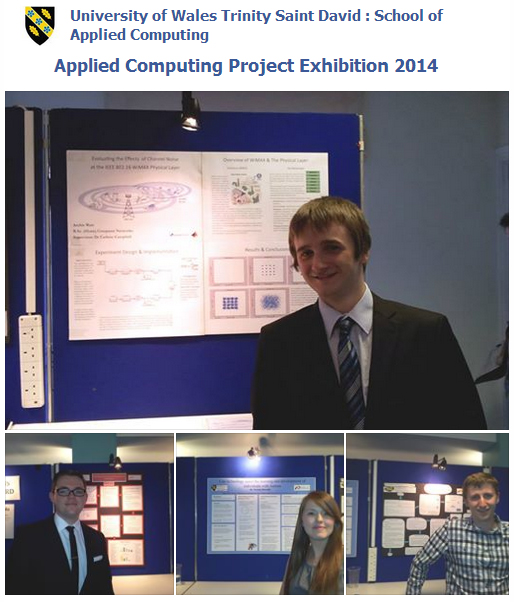
Applied Computing Project Exhibition 2014

blog-cover

Deborah Roberts: Web Developer @ DAC

29dd4d8What was your HE course?
The course that I did was BSc (Hons) Web Development.

What is your job title and role?
My job title is web developer/technical auditor at the Digital Accessibility Centre (DAC). My role varies to include design and development of small SME websites, Mobile Apps, technical auditing, accessibility testing and reporting on larger websites including clients such as Channel 4, Money Advice Service, HMRC, Lloyds, Santander and many more.

Could you briefly describe the organization you work for?
The organisation I work for deals with the accessibility testing of digital products to WCAG 2.0 standards. We have a team of expert testers that have a range of disabilities and use various Assistive technologies to ensure that these products are accessible and inclusive to all.

Which skills learned at University are helpful to you in your job?
The skills that I learnt at University that I have found help me are web design and development skills, report writing, how to research and meet deadlines and the final project that I undertook relating to accessibility and accessibility guidelines.

Do you have a typical day and how would you describe it?
I can be involved in any part or all of the process depending on how many audits are on-going. I could be working with the testers where I analyse code as they find accessibility issues with a website or mobile app in relation to their assistive technologies. I will then find the reason for the problem and offer companies a solution for fixing it.

I will then complete a technical audit and compile a report. This process is then followed up with a conference call with project managers and developers/designers to discuss a way forward for compliance.

I have also been involved in training developers, designers and project managers in creating accessible products, selling the service to clients and presentations.

A colleague and I also developed the Accessibility ‘hub’ for Virgin Media’s website.

What aspects of your job do you enjoy most?
I do enjoy getting out of the office and visiting companies all over the UK and seeing how they work. I have recently been to HMRC offices after being involved in a piece of work for them, along with Channel 4, ITV and Virgin. But the part that I like is the analysing of code, finding the reason why a screen reader for example is not working with the code and finding a way of fixing it. It is also nice to see the fixes that I have suggested being implemented and no longer causing my blind colleagues an issue.

Do you have any advice for students who would like to start a Career?
Yes, work hard and stay focussed, if you’re determined you’ll get there.

IT and Business Development jobs

jobsites

IT and Business Development jobs in Swansea Caerphilly Cardiff and London:

Industry News: Technology Sector

bigstock-Tablet-computer-and-business-o-52164853

There has been very positive news this year regarding job creation in the Technology sector. As the extracts from the Financial Times article ‘UK technology job creation‘ indicate “Rates of job creation at UK technology companies have outpaced the private sector as a whole for the past four years.”

This is likely to do with the natural refresh cycle of the Tech sector that occurs every 5 years, making the Technology sector a lot more resilient to economic downturns, e.g. that occurred between 2008 and 2013.

The article continues “The number of jobs in the sector now exceeds 1m out of a total of 28m employees across all UK sectors, compared with 915,000 out of 27m in 2010, confirming that technology is a significant employer in Britain… Jobs in the tech sector rose 4.3 per cent year on year in the first half of 2013 compared with 0.9 per cent jobs growth for the private sector as a whole… The report finds that business activity growth at UK tech companies is the fastest since May 2010. It says: “The figures show that UK tech company output rebounded strongly after the global financial crisis . . . and has now expanded throughout much of the past four years.”

To read the full article please click-here.