Turn On Your Future @ UWTSD's School of Applied Computing & Electronics

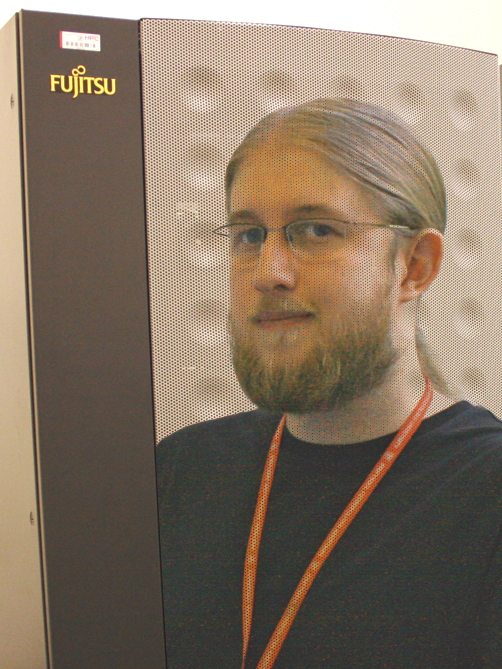
In this week’s post the School of Applied Computing’s Senior Research Associate, part-time Lecturer and all-round Great Guy Tim Bashford tells us about his research activities:
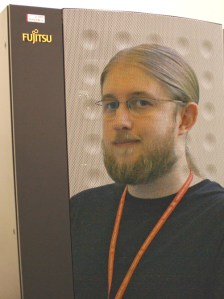
Cluster_Tim_little

I enrolled on a PhD having graduated from the University’s Software Engineering BSc Degree with first class honours.  My PhD thesis topic is rooted heavily in computational physics, developing parallelism frameworks for numerical modelling of radiative, thermal and wave propagation.  My areas of academic interest include software engineering, high performance computing, computational physics and robotics. I was born and raised in South Wales, and still live on the beautiful Gower peninsula.  Outside of work, I am a keen photographer, and enjoy computer gaming, martial arts and swimming.

My research falls into the area of simulation; how light, specifically laser light, interacts with human tissue.  There is a practical, clinical agenda for this research; lasers are now used throughout medical and cosmetic therapies for applications ranging from laser hair removal to the treatment of tumours.  It is especially with consideration of cancer treatment that my research is focused, but with the potential for application to any of the listed areas.

The Monte Carlo Method

The Monte Carlo method was developed in the late 1940s as a method of repeated random sampling to obtain numerical results.  In the case of particle physics, the Monte Carlo method was used to consolidate two distinct approaches for simulation of physical phenomena; low particle count classic mechanics problems simulated through differential equations and high particle count problems approached through statistical mechanics.  By taking a probabilistic approach, the Monte Carlo method models multiple instances of the same measurable unit to obtain a numerical result without the need for more abstract thinking.  By taking a profile of a particle and expressing it mathematically, representing the probability of a given, known event occurring, it is possible to create a computational model to simulate that particle, incorporating each potential event through the implementation of a pseudo-random number generator.  By then simulating a sufficient number of instances of the implemented particle following random events, the probability inherent in the method will result in a theoretically accurate overview.

This process for simulating the subatomic particle of light, the photon, is already well established, but based on Cartesian geometry.  This ultimately results in simulation of cuboid geometry which, while an acceptable overview, reduces the accuracy to the point that use of the data generated could introduce unnecessary risk in a clinical setting.  As such, I have developed a model whereby accurate CT or MRI data may be simulated and damage to the cells within calculated.  This theoretically will permit a medical doctor to test the outcome of a given laser treatment without risking the patient’s safety.

Computational efficiency

Due to the probabilistic nature of the Monte Carlo model, an inevitable relationship is formed between the simulated particle count, the accuracy of the result and the time taken.  The extent to which this is true varies significantly by the degree to which random number generation features in the model; a simulation which is only nominally impacted by random elements requires a smaller particle count, while for a simulation on which random numbers make a significant impact the opposite is true.

As such, it is highly desirable to simulate as many photons as possible, however in doing so, a linear relationship is formed between photon count and time taken; if 10,000 photons take 1 minute then 100,000 photons will take 10 minutes.  This is a fact of the Monte Carlo model, thus a focus on speed is instead centered on maximizing performance from hardware.

The University has its own 33 enclosure Transtec Windows High Performance Computing cluster, and an on-site 13 enclosure Fujitsu Windows/Redhat cluster provisioned by HPC Wales and it is through these supercomputers that simulations may be completed more quickly.  I have therefore ported the algorithm and associated structures to utilise the Message Passing Interface (MPI) on high performance supercomputers, resulting in order of magnitude time improvements, thus improving the clinical accuracy of the model without impacting on time taken.  The next step of this process is to port the model to the Compute Unified Device Architecture general purpose graphics processing framework, where, through use of an Nvidia Tesla module, further order of magnitude speed increases are predicted.

infoeconomy

New research shows growth in the Information Economy is twice the UK average.

e-skills UK, Intellect and BCS have issued a new report which shows the growth in the Information Economy. The number of people working in the Information Economy industries grew 8% over the 2009-12 period – a rate four times that recorded for the UK workforce as a whole.

“This research shows that tech in the UK and the wider Information Economy is in robust health,” says Julian David of industry body Intellect. “The UK tech sector is critical to the national economy – across all industries we employ more than 1.4 million people, representing 5% of the total UK workforce. Tech in the UK sits at the heart of all kinds of activities and advances, from education to energy and from finance to fashion. This research is a timely reminder that continued economic recovery is critically dependent on digital expertise – and that the UK tech sector is well placed to lead it.”

“Employers across the Information Economy are committed to driving growth further and faster,” adds Karen Price, CEO of e-skills UK. “They know that, with the right skills in place, the UK has the potential to be a global leader in the digital industries. They are working together to ensure that as a nation we have the skills base to take advantage of the opportunities. It’s rare to see such unity of purpose in an industry – but if the stakes are high, the possibilities are boundless.”

Click here for more key findings and to access to the full report.

ac-logo-newApplied Computing Staff and Students Learning, Teaching, Playing and Experimenting with New Technology

blog1

FDM are always on the look out for talented people with great potential to join their team. FDM Group’s award winning graduate programme is designed to help graduate students bridge the gap between academia and employment.


FDM Group is the UK’s largest employer of IT Graduates and has launched the careers of over 3000 graduate students to date. FDM Group is an international IT services company, headquartered in Brighton, United Kingdom with offices in London, Manchester, New York, Frankfurt, Zurich, Luxembourg, Hong Kong and Singapore. The company provides services for project management, infrastructure support, application support, software testing, software development and training.

In a bid to combat the shortage of women in IT, FDM has implemented an initiative that promotes and encourages women to launch a career in IT. FDM has also established a female mentoring programme where our ‘Female Champions’ mentor fellow colleagues and organise events to raise awareness of the attractive opportunities for women in the IT industry.

The FDM Graduate Programme provides high-quality training to prepare Graduates for a rewarding Career as part of the FRM Group. For more information about the FDM Graduate Programme please click-here.

A mini documentary investigating career opportunities in IT and Technology. In this video, technology role models discuss what the future holds for the IT Industry and what that means for careers:

Who are the best people to advice businesses on how to embrace and use New Technology such as Social Media, Mobile Apps and Cloud Computing: You, the new upcoming Generation and Graduates of today.

prosper_logoProsper Recruitment are currently seeking Graduates and Postgraduates for exciting job opportunities in the field of Software Development:

Software Developer (Ref. 3110) : Gwent

> Permanent  £30-£33K
Our client is a leader in the manufacture and supply of high quality products for the financial and retail sectors. They currently have an opportunity for an experienced Software Engineer to join their team as soon as possible

Main Duties

  • To design, support and maintain the company’s software products and applications
  • Assist internal and external customers to derive appropriate software specifications for products.
  • Manage and develop new software projects through the entire development lifecycle.
  • Design, develop and validate software changes in compliance with approved procedures and within agreed timescales.
  • Manage temporary or contract personnel on PC-software projects.
  • Provide advice, support and training on software use to staff and customers.

Candidate Requirements

  • A relevant degree or equivalent with proven programming experience
  • Experience of C# and .NET framework and JAVA on a Windows platform.
  • Familiar with ASP, AJAX, CSS
  • Experience of RS232 and USB communications protocols
  • Experience of Microsoft SQL databases.
  • Knowledge of embedded C would be an advantage but not essential.
  • Excellent analytical, numeric and interpersonal skills.
  • Strong team player, flexible and customer-focused

Software Developer (Ref. 3109) : Swansea

> Permanent
Our client operates on a worldwide basis delivering the best Control of Work software tools and support services to the largest multinational oil, gas and chemicals companies in the world. They are seeking a talented individual to enhance their development team.

Main Duties

  • To support the company’s specialist software
  • Work with the development team at all stages of the development lifecycle
  • To research and take advantage of the latest technologies and advances

Candidate Requirements

  • Good degree in Computing or IT related subject
  • Proven experience of all stages of IT Product Design
  • Experience of using ASP.NET, .Net Framework, C# and SQL is required
  • It would be useful if you have knowledge in any of the following: HTML / CSS, JavaScript, MSSQL / Oracle, XML, Visual Studio
  • Excellent awareness of the latest technologies
  • Excellent communication skills with a good standard of written and spoken English
  • Self motivated team worker able to work unsupervised to tight deadlines
  • To be able to travel as there may be opportunities with this role

IT Manager (Ref. 2674) : South West Wales

> Permanent : Circa £35K
Our clients are established and highly successful medium sized coming offering services to manufacturing companies throughout the UK. The company are currently seeking to recruit an experienced IT Manager to play a key role in maintaining and developing their networked systems to support the business

Main Duties

  • Lead IT operational and strategic planning to suit business strategy
  • Benchmark, analyze, report on, and make recommendations for the improvement and growth of the IT infrastructure
  • Manage financial aspects of all IT, including purchasing and budgets
  • Develop and implement all IT policies and procedures, including those for architecture, security, disaster recovery, standards, purchasing
  • Manage the deployment, integration, monitoring, maintenance, development, upgrade, and support of all IT systems, including network servers, company website, telephone systems, PCs, operating systems, hardware, software applications, technical support
  • Manage small IT team including recruitment, supervision and development
  • Maintain, monitor, update and improve company website

Candidate Requirements

  • Strong technical knowledge of PC operating systems, networking, website and communication technologies and protocols
  • Strong technical knowledge of current network hardware, architecture design, and standards
  • Experience with Sage and SQL server database management systems
  • Ideally you will have experience in web / software development programmes
  • Proven experience in IT infrastructure planning and development
  • Ability to manage Managing Multi sites
  • You will have strong leadership and interpersonal skills
  • Ideally understanding of human resource management principles, practices, and procedures

Take a look at our current vacancies at: www.prosperec.co.uk and register today by emailing your CV to info@prosperec.co.uk.

eskillslogo

New and in-depth research among employers has exposed the full potential of the digital sector to boost economic growth, but has also laid bare some significant skills shortages.

The next ten years will see the digital sector become a powerhouse of the UK economy, predicts the report. Green IT and cloud computing will change the way organisations work, while mobile technology will continue to transform individuals’ relationships with business. Big data will put unprecedented power in the hands of enterprises with the skills to analyse it. And underlying all this activity will be the need to ensure safety and security, whether that’s protecting the UK from cyber attack or keeping citizens’ banking details private.

The digital sector directly contributes nearly £69bn to the economy and has been resilient to recession: since 2009 employment in the sector has grown more than three times the average for the whole economy. Maintaining this growth and realising the sector’s full potential will require escalating recruitment at higher skill levels: currently, nearly 20% of vacancies are difficult to fill owing to skills shortages. Given the increased need for deep technical skills alongside interpersonal, team-working and project management capability, people with a rounded and multi-disciplinary training are in particular demand.

“This research emphasises how central technology is to the economy,” says Karen Price, CEO of e-skills UK. The research was commissioned by the UK Commission for Employment and Skills, and carried out by e-skills UK, the employer body for the digital industries. One of the key findings is that there is a growing need for high level IT specialisms, such as IT Architects, Big Data and Security specialists.

To access the full report please click-here.

Prospects

Excellent Business Technology & Software Development Opportunities for IT & Computing Graduates @:

Landrover

Civil Service

EDW Technology

Ryland Technology Ltd

CapGemini UK Plc

Euopean Patent Office

TkMaxx

Telefonica

JP Morgan

Jaguar

Nestle UK Ltd

Stand Life Group Plc

Morrison Plc

 + Many more: please click here.

A mini documentary by BigAmbition investigating career opportunities in IT and Technology and the varied routes into the industry. In this video, technology role models provide an overview of the IT industry and how it’s shaping our world.