Turn On Your Future @ UWTSD's School of Applied Computing & Electronics

Archive for the ‘Uncategorized’ Category

Merry Christmas and a Happy New Year

The School would like to wish ‘all’ of our students and Graduates a Very Merry Christmas and a Happy New Year x

christmas_tree_05

ref

Home Sweet Homies @ the Founders Hub in Cardiff

Sue-and-luf

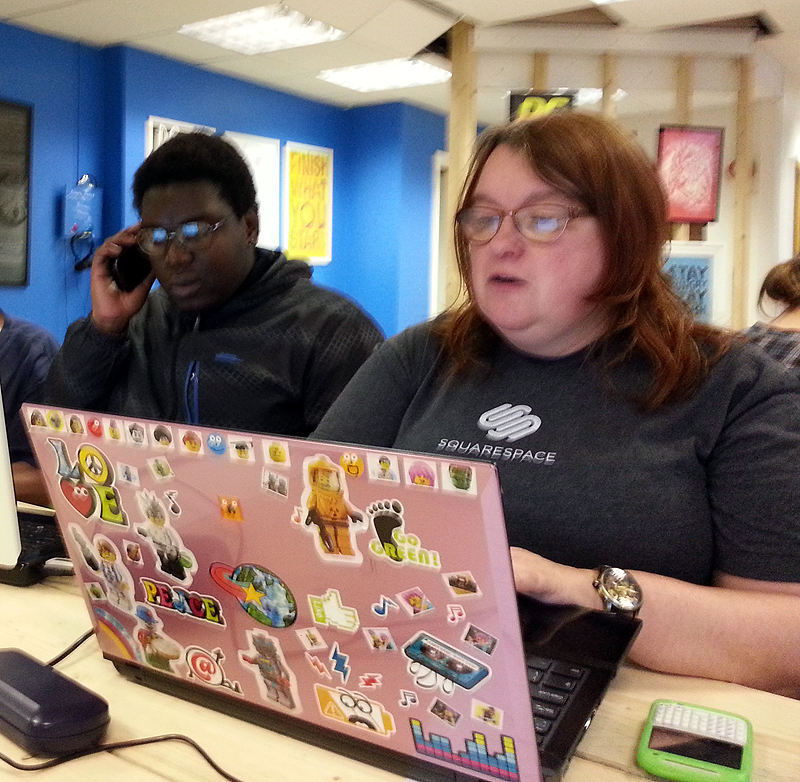
In this week’s article Sue Maw (pictured above: right) one of the School’s Lecturing Team provides a review of the Good for Nothing Home Sweet Homies event at the Founders Hub in Cardiff. A great initiative that provides people with the opportunity to apply their skills to help support and solve charity and social enterprise problems.

Just in case you don’t know who we are: we are Good For Nothing Cardiff. We organise events (24, or 48 hours) that bring together a bunch of people with a wide range of skills and talents – makers, thinkers, do-ers, designers, planners, and everything in between – to help accelerate local causes that are focused on delivering social &/or sustainable good. This gives the causes concentrated access to a pool of talent that would normally be out of their reach.

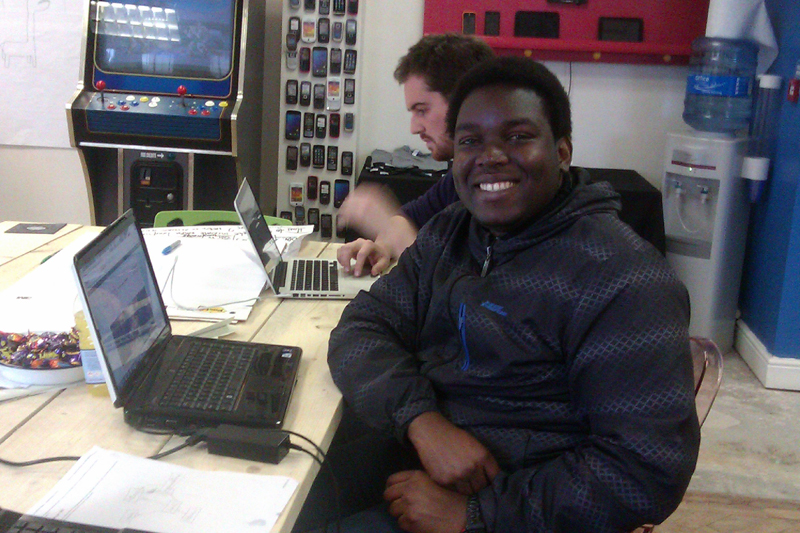
Sue: On the 6th and 7th of December I went along to the Good for Nothing Home Sweet Homies event in Cardiff along with two final year students, Lufwendo (also picture above: left) and Jen.

It was billed a cross between Challenge Anneka and the A Team: we had to explain what that meant to younger participants. The venue was the Founders Hub in Cardiff which is one of the new breed of work and meeting places. It was a lovely space with the obligatory giant lego man head and retro gaming machines :-).

The aim of the event was to spend Friday evening and Saturday creating resources for two charities. There were participants with creative, business and computing skills. On Friday the two charities, Hafan and Oasis, outlined problems they were having, such as poor Web presence and the increased need to record charity beneficiaries for future funding applications. Jen came up with an awesome business and sustainability plan for Oasis.

On Saturday, Lufwendo and I were racing against the clock to produce a client database for Oasis, a charity working with asylum seekers. Our task was made more complicated by the fact that the solution had to be open source so the software we were using did not have all the features we expected. We had a design expert give us some good advice on form-layout and we made use of some great banners a graphic designer produced for the charity. As the clock ticked down the final seconds we finished off our last report – I’m sure students never work to deadlines that closely!

luf

The event worked purely on donated time and resources: there was no budget. I should mention that there was awesome food, some of it cooked by the asylum seekers group. I especially liked the way that I kept getting handed cups of coffee as I worked. There is another event in the spring in Cardiff which I’ll pass on as soon as I know the dates. And of course it would be awesome to have a similar event happening in Swansea. Apart from the warm glowing feeling of having helped a charity, students have something interesting for their CV, a fun experience and networking with local business contacts.

TechHub Swansea Launch Party

techhubTechHub Swansea is a New community and workspace for tech entrepreneurs in the City and becomes the fifth TechHub location after London and Manchester in the UK, and Riga and Bucharest in Europe.

TechHub  with links to Google and Blackberry, nurture tech entrepreneurs,  and provide a place where they can work, meet, collaborate, network, learn and have fun. TechHub state:

“We provide physical and virtual spaces that enable technology startups to work smarter, develop faster and increase their chance of success. How? Through our one-vision global community… Entrepreneurs and their teams drop in or set up shop, advice flows freely (so does beer and pizza), angels appear, relationships blossom.” (1)

The TechHub community and workspace in Swansea is designed to create opportunities for entrepreneurs and start-ups in the region to create new products and hi-tech jobs in and around the City.

In an article for WalesOnline by Rupert Hall,  Matt Warren, entrepreneur and co­founder of TechHub Swansea said:

“We’re thrilled! Opening a TechHub in Swansea will massively boost the region’s existing tech businesses and help them compete on an international scale, while also being five minutes from the beach.” (2)

In a recent Blog post TechHub state:

“We are proud to partner with the Welsh Government, both local Universities and of course our global partners, Google, Blackberry and Telefonica’s BlueVia to bring TechHub to Swansea.” (3)

TechHub Swansea launch party will be on Friday 13th December 2013, for more information please click here: http://www.techhub.com/blog/techhub-swansea-launch-party/

Guest Speaker: Edd Turtle in a Startup Culture

Edd Turtle

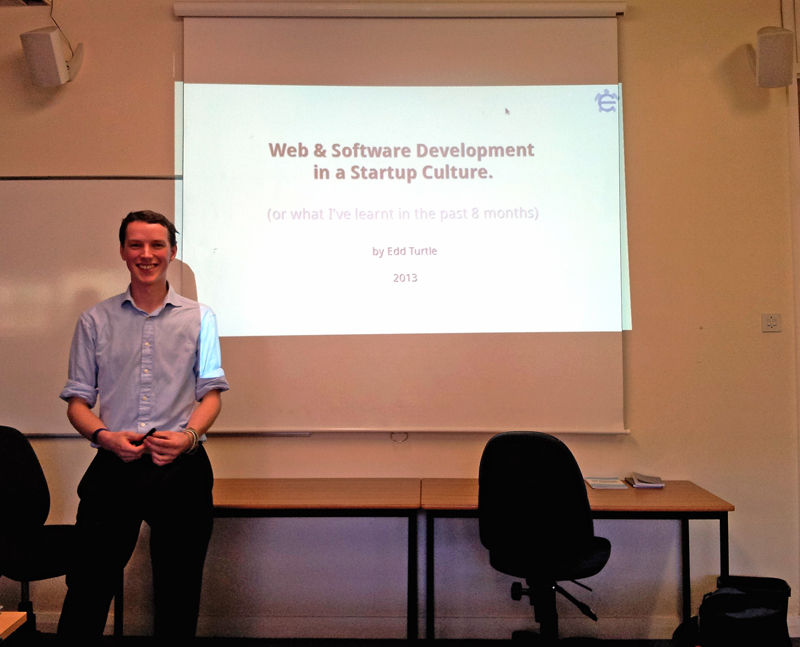
Edd Turtle, a graduate from University of Wales Trinity Saint David in Software Engineering, recently gave a presentation about ‘Web & Software Development in a Startup Culture’. The presentation spoke about both the software principles used in industry and opportunities for any students looking to start their own company.

Edd is the lead developer at a local startup company called Hoowla, which is an online conveyancing solution helping buyers, sellers and their solicitors to collaborate on cases together. The first part of the presentation focused on how cloud computing is used within Hoowla and other companies to maintain it’s online stability and scalability.

The latter half of the presentation focused primarily on the opportunities available to students in the local area, highlighting that there are technology companies (and jobs) in South Wales.

The School would like to thank Edd for returning to the School of Applied Computing to share his experience and knowledge with our current students, and we look forward to future collaborations.

Video: Discover University of Wales Trinity Saint David

Learn more about the Exciting Changes within Welsh Higher Education and the Newly merged Swansea Metropolitan University and the University of Wales Trinity Saint David and the exciting plans for the future – check out the Discover University of Wales Trinity Saint David Video below as the Vice-Chancellor Prof. Medwin Hughes explains all:

uwtsd

Research Profile: Virtual Reality e-Counselling Service in Wales

Researchers at the Centre for Psychology & Counselling and School of Applied Computing at Swansea Metropolitan (University of Wales: Trinity Saint David) have received funding from Tenovus, Wales’ leading cancer charity, through its innovation grant funding scheme to develop and evaluate an on-line counselling service for young people in Wales who either have a personal diagnosis of cancer or who are caring for someone with cancer.

CEvolve_team_SMU_8302

Lead applicant, Dr Ceri Phelps, a Health Psychologist at Swansea Met, stated that:

“young people across the South West Wales area will be involved in all stages of this exciting project including its initial design. The e-counselling service will take the form of an avatar-based virtual reality counselling world in a format familiar to many young people today who use computer games machines such as Microsoft’s Xbox 360 and Sony’s Playstation 3. If shown to be successful, the virtual reality counselling world may be adopted by Tenovus for ongoing delivery of cancer support services to young people throughout Wales with huge scope for offering a wider alternative to face-to-face counselling for all age groups”.

Technical Lead, Andrew Baker from the School of Applied Computing, having extensive experience working in Real-Time Computer Games Development is overseeing all technical and creative aspects of the project. Andrew said, “This is a very exciting project to be involved in which incorporates Applied Research across a broad spectrum of disciplines.” Young people feel comfortable with the whole concept of avatars.

FrontPage_Screenshot2

The Project Team recently presented the ‘Health Psycology in Action‘ poster at the Tenovus Research Conference in Cardiff (SWALEC Stadium) and received very positive feedback. Furthermore, the Project has also recently been commended by the NHS Ethics committee. This is Fantastic news as the Project now progresses to phase 2. Congratulations to all involved in this highly innovative contemporary and benevolent initiative.

Dr Ian Lewis, Head of Research for Tenovus said,

“Our Tenovus Innovation Grants offer new research opportunities to discover ways to reduce the impact of cancer.  With cancer incidence in Wales amongst the highest in the world, we need to develop new and innovative ways to help support people not just throughout the duration of their cancer treatment, but beyond.”

tenovus

Mini-Video: Career opportunities in Technology

Check out this mini documentary investigating career opportunities in Technology and how to break into the IT industry:

itind

Guest Speaker: Andrew Thomas of Brightseed Ltd.

AndrewAndrew Thomas pictured above, a Graduate of the School of Applied Computing, now a Successful Entrepreneur and Technical Director of Brightseed Ltd. located on the Mount Pleasant Swansea Campus, recently spoke with undergraduates at the School about Entrepreneurship and openly shared what it is like to create and run your own Company. Sharing many hints and tips along the way Andrew’s talk was very inspiring and part of the University’s Global Entrepreneurship Week (GEW) programme of events.

Building on a strong technical experience gained within a large corporate environment, Brightseed was born out of the passion of providing a quality service to customers with a strong emphasis on a quality product and support.  The partnership with a strong Creative talent (Simon Lee, Creative Director) has propelled Brightseed into a strong position.

The University’s Global Entrepreneurship Week co-insides with News that the University of Wales Trinity Saint David’s place as a world-leading authority on enterprise and entrepreneurship education has been further enhanced as a senior United Nations (UN) official is set to spend the next four months at the University to learn about its work and to develop new educational approaches that improve international educational provision and inform new policy developments.

For more information please click-here.

The pay and perks of a career in Information Technology (IT)

In this video, technology role models explain the rewards of working in IT and Technology:

Research: Simulation of Light with Human tissue

In this week’s post the School of Applied Computing’s Senior Research Associate, part-time Lecturer and all-round Great Guy Tim Bashford tells us about his research activities:

Cluster_Tim_little

I enrolled on a PhD having graduated from the University’s Software Engineering BSc Degree with first class honours.  My PhD thesis topic is rooted heavily in computational physics, developing parallelism frameworks for numerical modelling of radiative, thermal and wave propagation.  My areas of academic interest include software engineering, high performance computing, computational physics and robotics. I was born and raised in South Wales, and still live on the beautiful Gower peninsula.  Outside of work, I am a keen photographer, and enjoy computer gaming, martial arts and swimming.

My research falls into the area of simulation; how light, specifically laser light, interacts with human tissue.  There is a practical, clinical agenda for this research; lasers are now used throughout medical and cosmetic therapies for applications ranging from laser hair removal to the treatment of tumours.  It is especially with consideration of cancer treatment that my research is focused, but with the potential for application to any of the listed areas.

The Monte Carlo Method

The Monte Carlo method was developed in the late 1940s as a method of repeated random sampling to obtain numerical results.  In the case of particle physics, the Monte Carlo method was used to consolidate two distinct approaches for simulation of physical phenomena; low particle count classic mechanics problems simulated through differential equations and high particle count problems approached through statistical mechanics.  By taking a probabilistic approach, the Monte Carlo method models multiple instances of the same measurable unit to obtain a numerical result without the need for more abstract thinking.  By taking a profile of a particle and expressing it mathematically, representing the probability of a given, known event occurring, it is possible to create a computational model to simulate that particle, incorporating each potential event through the implementation of a pseudo-random number generator.  By then simulating a sufficient number of instances of the implemented particle following random events, the probability inherent in the method will result in a theoretically accurate overview.

This process for simulating the subatomic particle of light, the photon, is already well established, but based on Cartesian geometry.  This ultimately results in simulation of cuboid geometry which, while an acceptable overview, reduces the accuracy to the point that use of the data generated could introduce unnecessary risk in a clinical setting.  As such, I have developed a model whereby accurate CT or MRI data may be simulated and damage to the cells within calculated.  This theoretically will permit a medical doctor to test the outcome of a given laser treatment without risking the patient’s safety.

Computational efficiency

Due to the probabilistic nature of the Monte Carlo model, an inevitable relationship is formed between the simulated particle count, the accuracy of the result and the time taken.  The extent to which this is true varies significantly by the degree to which random number generation features in the model; a simulation which is only nominally impacted by random elements requires a smaller particle count, while for a simulation on which random numbers make a significant impact the opposite is true.

As such, it is highly desirable to simulate as many photons as possible, however in doing so, a linear relationship is formed between photon count and time taken; if 10,000 photons take 1 minute then 100,000 photons will take 10 minutes.  This is a fact of the Monte Carlo model, thus a focus on speed is instead centered on maximizing performance from hardware.

The University has its own 33 enclosure Transtec Windows High Performance Computing cluster, and an on-site 13 enclosure Fujitsu Windows/Redhat cluster provisioned by HPC Wales and it is through these supercomputers that simulations may be completed more quickly.  I have therefore ported the algorithm and associated structures to utilise the Message Passing Interface (MPI) on high performance supercomputers, resulting in order of magnitude time improvements, thus improving the clinical accuracy of the model without impacting on time taken.  The next step of this process is to port the model to the Compute Unified Device Architecture general purpose graphics processing framework, where, through use of an Nvidia Tesla module, further order of magnitude speed increases are predicted.