Turn On Your Future @ UWTSD's School of Applied Computing & Electronics

Posts tagged ‘Digital Arts’

Echoes of Absence by Jon Frise
Q.  Name & Course? Jonathan A. Frise, BA (Hons) Animation & VFX at UWTSD

Q.  Project overview & introduction?

Echoes of Absence, production title The Bunker. Is a short characterless 3D animated environment piece, about three minutes. I built it to test whether lighting and sound design alone can make an audience feel like something happened in a place before the camera ever got there. Pipeline was Blender for asset creation and block out, this was my pre-production predominant phase including early testing and pre-viz, Unreal Engine 5 for lighting and final render, DaVinci Resolve for edit, grade and sound.

Q.  What was the motivation for choosing the project?

I’ll be honest, this project started out way bigger than what it ended up being, and that’s actually the most important part of the story. I’d been watching a lot of “liminal space” stuff online, think the Backrooms, POOLS, The Exit 8, that whole corner of the internet, and I kept getting stuck on the same question: why does an empty room unsettle people more than a monster jumping out at them? No character, no dialogue, sometimes barely any visuals at all, and somehow, it works better than most horror films manage.

That question became my dissertation hypothesis: “To what extent can lighting and sound design alone shape an audience’s interpretation of a preceding event in a characterless 3D animated environment?”

Originally this was going to be a proper first-person sci-fi piece, following a character called Jim and a little robot called Chips. Halfway through planning I made the call to cut the character completely. Not because the idea was bad, but because I realised I was about to spend a whole year juggling character animation, rigging, performance, environment art and sound design, and something was going to suffer for it. So I cut it back to the one thing I actually cared about most, and the project got better for it, not worse.
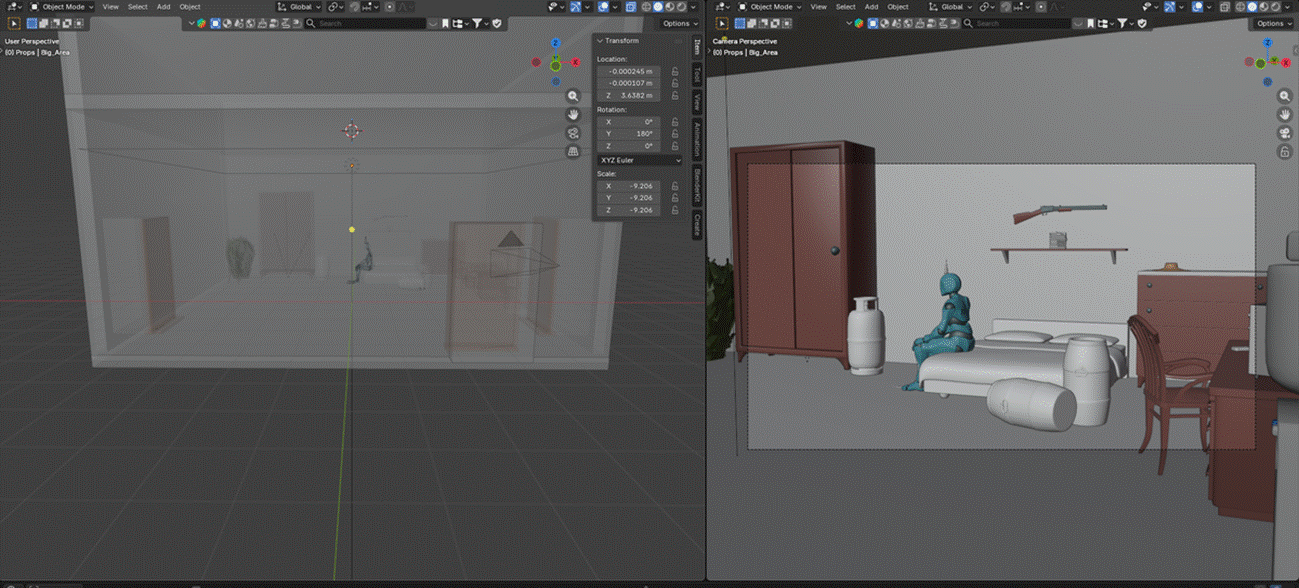
Fig.: Jim, before I cut him: An early blockout in Blender and Unreal, back when this still had a character in it.

Q.  Overview of the practical implementation?

The whole film hangs off one contrast. A flashing red alarm light throws long shadows down a corridor while Harry Nilsson’s relentlessly upbeat “Gotta Get Up” loops on a dying radio in the room beyond, happy sound against a horrible scene. I didn’t just trust that it would work though, I actually ran the experiment first. I stripped the audio off WALL-E’s opening in Adobe Audition and rebuilt it twice: once with nothing but wind and dust, once with the cheerful music dropped back in. Silence made it horror. Music made it tragic. That one test is basically why the whole radio idea survived into the final film.

Fig.: The radio itself. Everything in this film is built around this prop.
Fig.: The radio’s material graph. That worn black and orange finish didn’t happen by accident.

The radio sits at the centre of the film, but it only works because the room around it feels real. I didn’t just invent the bunker layout, I researched actual Cold War bunker floor plans and based the whole thing on one, keeping the same room logic: dorms, control room, comms room, rec and dining, a generator room, filtration and decontamination.
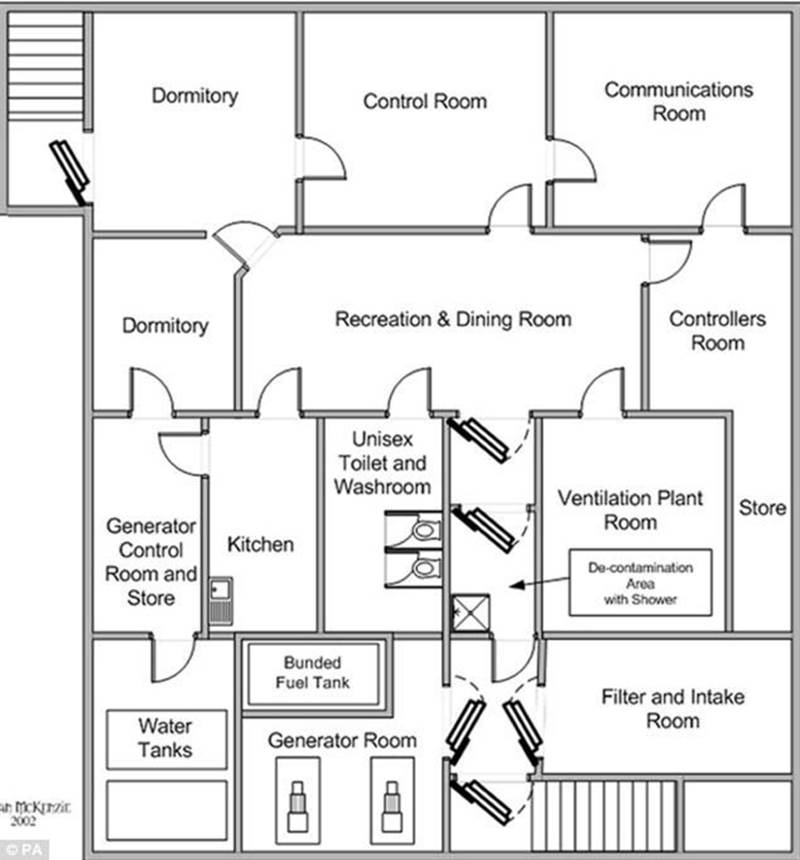
Fig.: The real Cold War bunker schematic I based the layout on.

The first version genuinely felt like a normal hallway, not a bunker, so I dropped in a 1.8m human reference cube and rebuilt everything around it, lowering ceilings and narrowing corridors until it actually felt claustrophobic instead of game-like. I sourced some assets ethically from FAB, Freesound and Pixabay rather than modelling everything from scratch, so I could spend more time on the two things the project was actually about: lighting and sound.
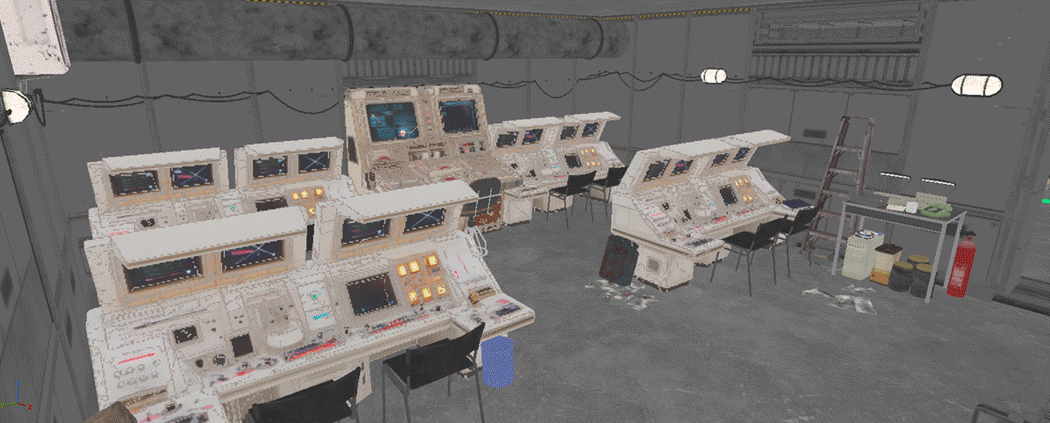
Fig.: The control room, built out one shift at a time

Q.  Most significant challenges and how you overcame them?

Two problems nearly wrecked it. First, Lumen’s global illumination really doesn’t like low-light scenes, and my dark corners came out grainy and unstable. I fixed it with a post-process volume, manually clamped the exposure, and bumped up the final gather quality until the shadows actually looked intentional instead of broken. Second, the radio’s sound was passing straight through solid walls, which killed the “finding the source” tension the whole scene depends on. I tried two fixes side by side, tweaking Unreal’s attenuation and occlusion settings versus building the spatial audio properly in DaVinci’s Fairlight, and ended up shifting the mix into post because it gave me way finer control.

I also kept everything religiously organised in the outliner and content browser as it grew. On a solo project, if a file goes missing or a save corrupts, there’s no one else around to bail you out.
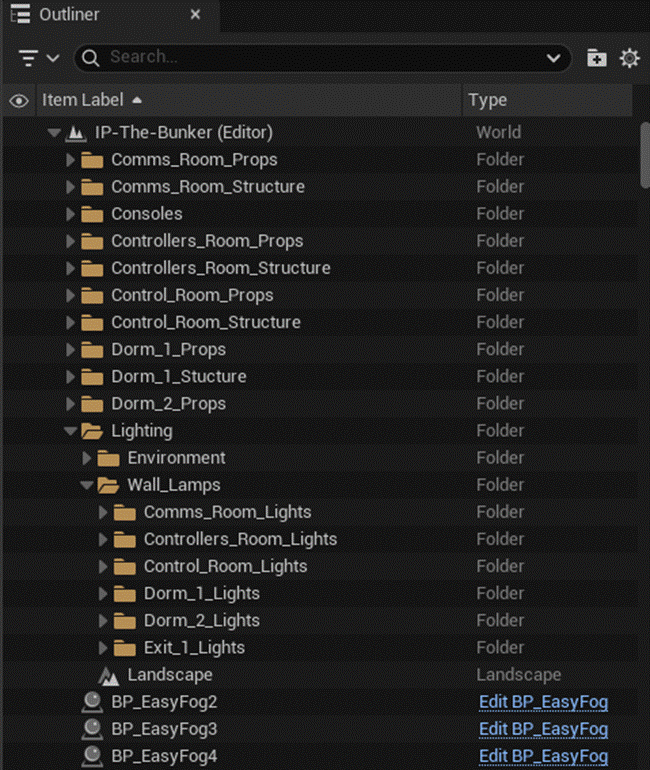
Fig.: The actual outliner. Every room gets its own folder, nothing left loose.

Q.  Most significant features?

My conclusion, honestly? Yeah, it held up. Sound and lighting on their own genuinely carried the weight of a missing character, to a significant extent anyway. I’m not going to pretend it’s bulletproof, the technique still needed some visual context, the physical bunker itself, to actually land. I’m also proud that I didn’t invent the bunker layout, I matched a real one room for room, and that I had the discipline to cut the project’s scope down to the one thing that mattered most instead of spreading myself across character animation, world-building and sound all at once.

Separately, before I cut the character, I actually built a physical prototype of Chips. I started with a cheap retro desk toy called LankyBot, stripped it right down and repainted it into a dull, aged copper finish instead of the factory chrome, then rebuilt the inside properly: real capacitors, exposed wiring with spade connectors, an old multimeter dial bolted to the side, a coiled copper aerial sticking out the top, and a dead iPhone mounted behind the screen panel as its actual display. It never made it into the final film, but it’s still sat on my desk, and I want to 3D scan it for a future project.
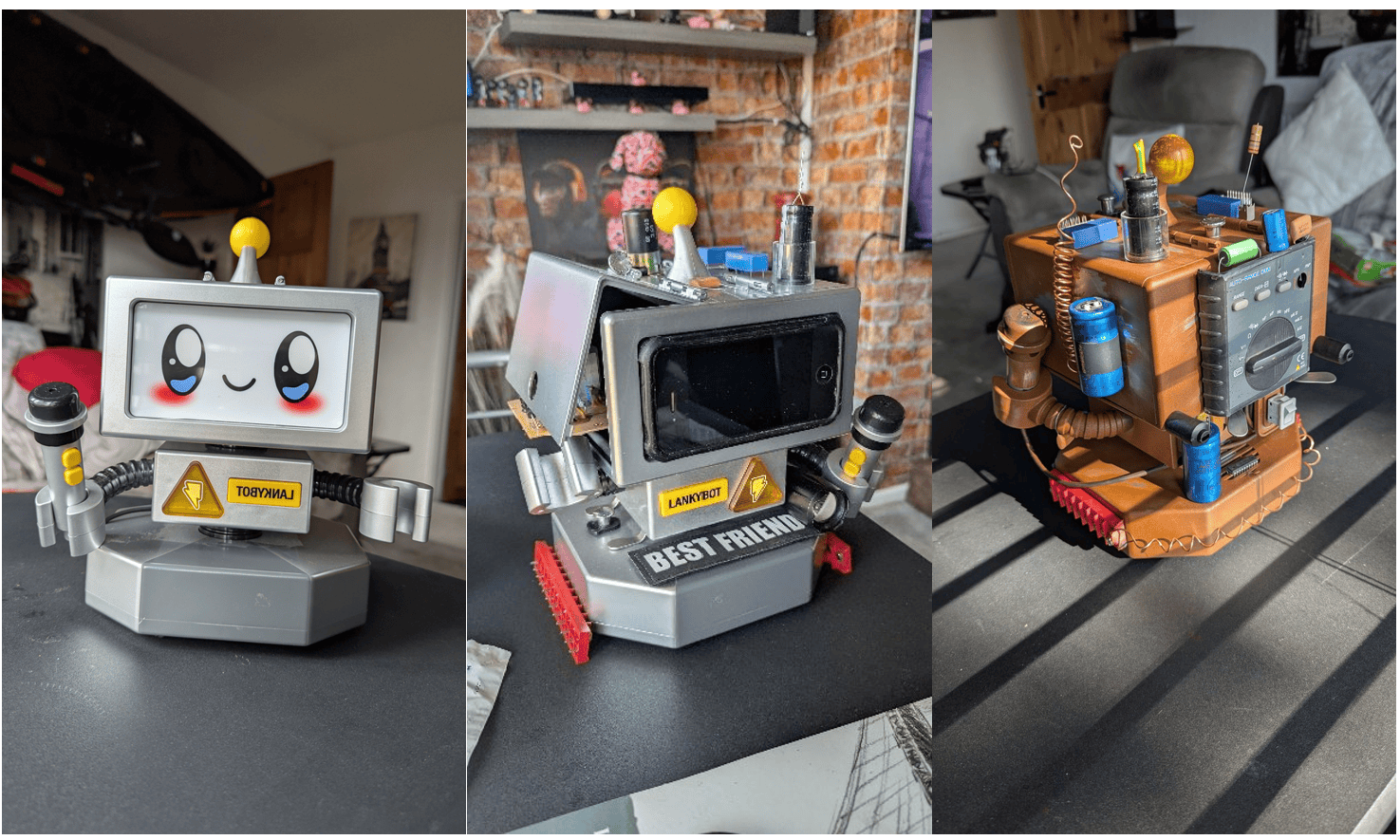
Fig.: Chips, the physical prototype I hand-built before cutting the character. Real electronics, real wear, real weight to it

Q.  Does your project have an online presence?

Yes. The final film, “The Bunker: ECHOES OF ABSENCE,” is on my YouTube channel JAF Games: https://youtube.com/watch?v=8BzGyFVEwbY. The full project write-up and blog also lives on a Notion page I built. You can also read the full dissertation this project came out of here (PDF).

Q.  Top tip/advice for students interested in completing a project?

Cut your scope before it cuts you. I started this project trying to do character animation, world-building and sound design all at once, from a much bigger concept, I even went as far as writing full feature-length scripts covering all sorts of facets. The second I admitted that was too much and dropped the character entirely, the project actually got good. It narrowed down into a specific area I could test methodically and actually had time to iterate on. Pick the one thing you care about most and go deep on that, it’ll show.

Stay open-minded, learn from others, and give it your all, because as cheesy as it sounds, that’s all any of us can do. And on AI specifically: I used it for structure and research, never for the actual creative thinking. If you can’t explain why you made a decision in your own words, you haven’t actually made the decision.

~

For more information about Computing & Digital courses at UWTSD please click-here.

Student profile: Hamza Qasim

Name: Hamza Qasim

What University course are you doing? MA Masters in Animation at UWTSD.
This follows my completion of a BA in Computer Games Design at UWTSD, where I spent 3 fulfilling years building my foundation in digital arts and game development.

What truly inspires me about animation and the broader field of digital arts is the unlimited creative potential it offers. I have a genuine passion for games, animation, VFX, and CGI, particularly the captivating effects seen in Marvel movies. The ability to bring ideas to life through digital mediums and create immersive experiences that can transport viewers into different worlds is incredibly motivating.

Video below: BA Game Design animation by Hamza Qasim

Beyond the creative aspects, I’m inspired by how this field connects to my other interests, especially automotive design. The intersection of technical precision and artistic vision in CGI, particularly in automotive visualisation, represents the perfect blend of my passions. What makes this journey even more inspiring is the supportive environment at UWTSD, where I feel encouraged to explore emerging technologies and push the boundaries of what’s possible in animation and interactive media.

Video below: Portfolio from BA Games Design Yr.3 by Hamza Qasim

Throughout my Masters program, I’ve been developing a diverse range of technical and creative skills. On the technical side, I’ve advanced my proficiency in 3D modelling, animation, texturing, and rendering using various versions of Blender (4.0, 4.2, and 4.4). I’ve also expanded into video editing and composition using Wondershare Filmora 13, along with comprehensive sound design capabilities.

Video below: Cans by Hamza Qasim

Video below: Koi by Hamza Qasim

Recently, I’ve ventured into VR development using Unreal Engine 5.5, where I’ve learned to create custom blueprints for asset switching, material switching, and targeted interactions. One of my proudest achievements has been developing a real-time sun movement system that enhances environmental immersion in VR experiences.

Video below: Material Switching & Sun Movement by Hamza Qasim

Beyond technical skills, I’ve been developing crucial soft skills through modules like Leadership, Management and Ethics. This module, though different from animation, has taught me about various leadership styles, management approaches, and proper research methodologies, skills that are invaluable for any creative professional.

Favourite Technology: My current favourite tool is definitely Blender. While we also learn Maya at University, I’ve found that the modelling and animation skills transfer seamlessly to Blender, and it offers several advantages that make it exceptional for independent learning and creative work. What I love most about Blender is its comprehensive nature, I can model, sculpt, texture, animate, composite, and render all within a single application.

The fact that it’s completely free removes financial barriers to learning, and the extensive community support through YouTube tutorials and forums means that virtually any problem I encounter has likely been solved by someone else. The accessibility and community aspect of Blender have been game-changing for my learning process. While Maya still has some advantages, particularly for UV unwrapping, the plugins available for Blender help bridge most gaps, making it an incredibly versatile tool for independent artists and students.

Video below: Liminal Spaces using Advanced Techniques by Hamza Qasim

After you Graduate?
My career aspiration is to work as a CGI Artist at an automotive company, with Mercedes-Benz being my preferred destination. This goal is informed by my previous experience working there before enrolling at UWTSD, which gave me valuable insight into the industry and confirmed my passion for automotive visualisation.

Video below: Car in motion by Hamza Qasim

The automotive industry’s increasing reliance on high-quality CGI for marketing, design visualisation, and virtual showrooms aligns perfectly with my skills in 3D modelling, animation, and rendering. My experience with both traditional animation techniques and emerging technologies like VR positions me well for the evolving demands of automotive CGI, where immersive experiences are becoming increasingly important.

Video below: Cloth Reveal by Hamza Qasim

Advice for students?
My most important advice is simple but crucial: do something that you truly enjoy. Don’t choose a course based on others’ expectations or perceived prestige, choose it for yourself and your genuine interests.

I love what I study because it encompasses everything I’m passionate about: games, animation, VFX, CGI, and automotive design. This genuine enthusiasm makes the work feel less like a chore and more like an exciting challenge. When you’re passionate about your subject, you naturally strive for excellence and find yourself more resilient when facing difficulties.

Fig.: Digital Arts image

Another key lesson I’ve learned is about perfectionism and deadlines. As an artist, I’ll always strive for perfection, but I’ve come to understand that sometimes you need to aim for the best work possible within tight deadlines rather than perfect work that never gets completed. It’s better to submit a strong, complete project than to miss deadlines chasing an impossible ideal of perfection. The balance between ambition and pragmatism is essential for success in any creative field.

Experience at UWTSD?
My experience at UWTSD has been absolutely transformative and couldn’t have been better. The support system here is extraordinary, from Richard Morgan in the Games Design department, who has been my rock throughout my three-year BA journey, to lecturers like Nabeel Masih, Adam Head, Philip Organ, and James Williams, who have consistently encouraged my growth and exploration of emerging technologies. The university’s holistic approach to student support extends beyond academics. The well-being department has been incredibly supportive during challenging times with my mental health, and the entire campus environment, from reception and canteen staff to lecturers, creates an atmosphere that feels genuinely supportive and nurturing.

I’ve had numerous opportunities for leadership and community involvement, serving as Student Representative for both my BA and MA courses and participating in the UWTSD Esports Committee, where we organised events and created lasting memories. The university even pushed me toward pursuing my Masters degree when I wasn’t initially planning to continue, a decision that has proven invaluable. The collaborative environment has allowed me to form lasting friendships with both staff and students, and I’ve been able to contribute through graphic design work for various university projects. If I could change anything about my university experience, it would be nothing, every aspect has been beneficial and has contributed to my growth as both a person and a professional.

~

For further information about Computer Games & Animation courses at UWTSD, please click here.