Turn On Your Future @ UWTSD's School of Applied Computing & Electronics

Archive for the ‘Uncategorized’ Category

START-UP Weekend Swansea is Coming :-)

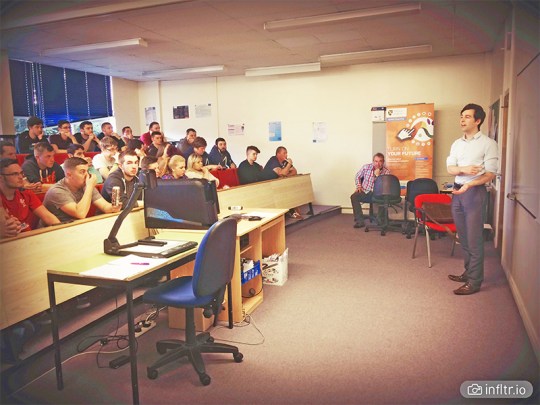
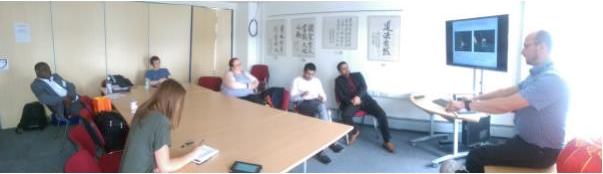
START-UP Weekend Swansea is Coming ;-). Below, SUW co-ordinator and Company Director Adam Curtis talks to UWTSD Computing students about the up-coming event:
Adam-Curtis2

For more information please click-here.

Computing at Schools Conference – 7th October 2015

A CONFERENCE ON THE FUTURE OF THE ICT CURRICULUM IN WALES

cas

The School of Applied Computing at the University of Wales Trinity St David is hosting a half-day ‘Computing at Schools‘ Conference on the 7th October 2015 from 1pm to 5pm.

The Conference will be taking a look at recent changes in ICT affecting the curriculum for Key Stages 1 to 4, and in particular at the New Computing Progression Pathways. We’ll be hearing talks from:

  • CAS – Computing at Schools – Wales;
  • CISCO Networking Academy;
  • Birmingham City University representatives; and
  • An IT skills and career-building program for learning institutions and individuals worldwide.

Location: Cadogan Conference Room, Mount Pleasant Campus.
Time: Wednesday 7th October 2015, 1pm to  5pm.
Fee: Free of charge.
Facilities: Refreshments will be available. Limited number of free NCP car park spaces are available.

To register for this event please click-here: http://www.uwtsd.ac.uk/applied-computing-visit-days/. If you need any further details, please contact kapilan.radhakrishnan@uwtsd.ac.uk or telephone 01792 481192acuwtsd

FACE @ UWTSD Graduate Summer school

The Faculty of Architecture, Computing and Engineering which includes the School of Applied Computing was actively involved in the UWTSD Graduate Summer school programme for 2015 at Lampeter. We had Guest Keynote speaker Ian Stewart from Arqiva speaking to us on the Internet of Things (IoT).

Here are highlights of the activities from our School and Faculty:

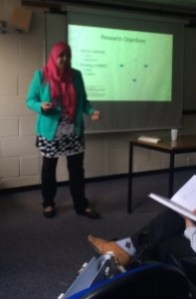
Thursday 2nd July 2015: Computing students present their research work and build a robot to climb unto a chair.
acs

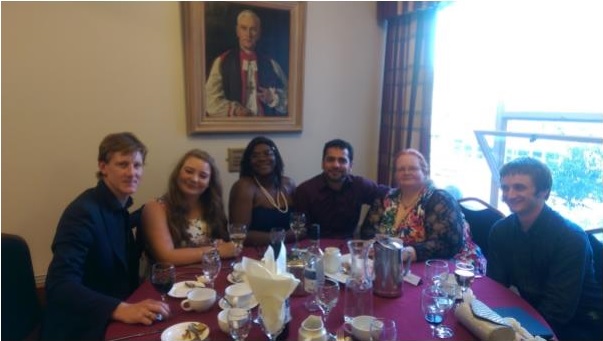
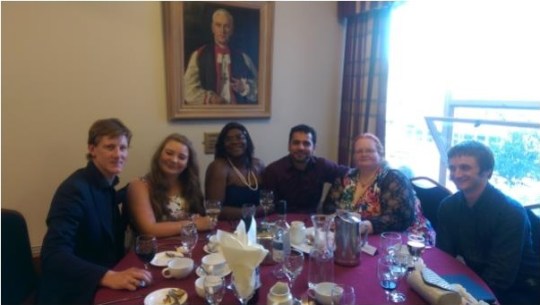
Thursday evening Formal Dinner at the Lloyd Thomas Dining Room:
acgroup

Friday 3rd, July 2015, Engineering Conference speakers highlights:

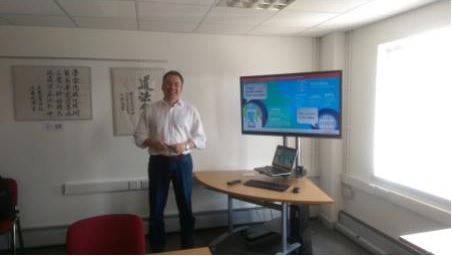
Session 1: IoT – Mr Ian Stewart
gspl

* Concept of IoT was outlined. “Connecting Digital lives and Services together”
* The vision (movement) was considered from multiple angles (i.e. economic, medicine, agriculture and etc.)
* One of the main points considered was the marketing aspect.
* Increase in use of sensor networks was outlined. By 2020 over 40% of Internet traffic will be generated by sensors.
* General information was provided about Arqiva and the nature of work they are involved with. (i.e. UK National television and radio broadcast, GSM infrastructure deployments and etc.)
* Involvement of Mr Stewart with multiple telecommunication companies across Europe in deployment and marketing aspects of their infrastructures.
* It was highlighted that “WE” (as individuals, academic institutions and corporate organizations) should have a strategy for surviving in the age of IoT (2020 – onwards).
* The scope of activities affected by IoT is vast and applications of such infrastructure are limitless.
* Mr Stewart also elaborated how in this day and age, we don’t necessarily need a significant amount of money to start a successful enterprise. It was highlighted that all the pieces are there, we just have to be clever in putting them together (i.e. Facebook).
* After the speech, possible research collaboration opportunities were discussed in brief. And such activities are to be scheduled for near future.

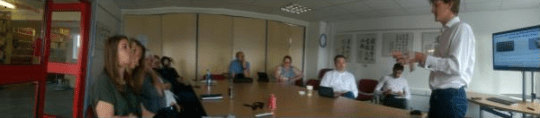
Session 2: FACE Research – Dr Caerwyn Ash
cae

* Speech was focused on Medical devices and their applications. A number of (Ideas/Developments) were outlined:
* Continuous improvement of some tools was discussed:

o Hearing aids: Electronics improvements
o Evolution of pacemakers

* iPhone as a medical device. (i.e. Monitoring health when running!)
* Particularly applicable to rural locations with lack of/limited access to healthcare systems.
* Monitoring patients via wristbands. Sensors to collect health data (i.e. heartbeat, blood pressure and …) to be analysed by healthcare professionals.
* Ideas as simple as pressing a button on a pill case to ensure elderly are taking their pills regularly.
* Asthma inhalers (regulated): monitoring usage to ensure proper administration of spray.
* Digital Stethoscopes to monitor patients better in harsh environments (i.e. WarZones)
* Ongoing research in muscular dystrophy. (aid of 3d printing)
* Ultraviolet blankets
* Skin Care products in general. (Skin Cancer detection from colour changes)
* Use of light to cure wounds which are not healing (i.e. in case of diabetic patients)

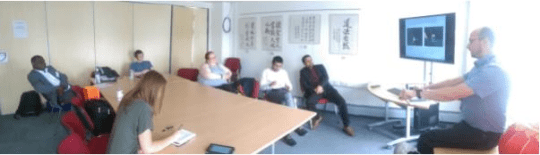
Session 3: Motorsport Research – Dr. Owen Williams
owen

* Involvement of FACE in motorsport research was outlined.
* A number of problems were identified such as:

o Difficulty in prediction of motorbike behaviour due to complex gyroscope physics.
o Lack of motorbike simulators.

* Use of sensors to collect data for each ride.
* Considerable differences were highlighted between motorbikes and other motor vehicles.
* Materials used in MotoGP was discussed.

A number of potential interdisciplinary research projects were identified:

o 100 channel logger at 1KHz.
o Fibre Optics for chassis parameter sensing.
o Built-in Eye-Tracker for bike helmets.
o Use of AI for simulator parameters identification.

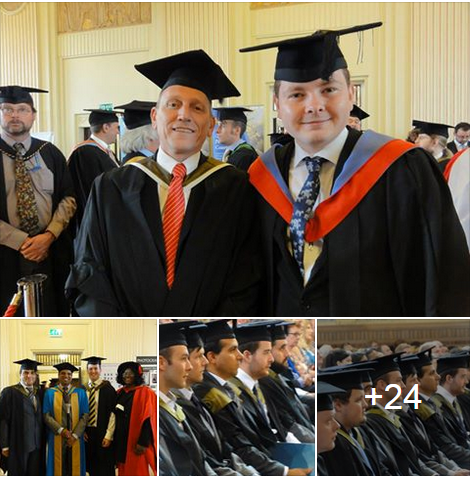
School of Applied Computing Graduation 2015

grad15

TEDxSwansea 2015

It was great to see so many friends colleagues and Graduates at TEDXSwansea. Thank you very much for your support and we hope you had a lovely evening :-). The Videos will be published soon, updates will be posted on the tedxswansea fb tedxswansea and twitter pages, for now here are some photographs of the event:

tedxs

Final Year Student Exhibition 2015 at Techhub Wales

Well done to all our students who participated in our Final Year Student Exhibition 2015 at Techhub last night. Also thank you to Techhub for hosting us! It was a great evening with a real buzz in the place – many of the employers who attended (DVLA, Veeqo etc) have sent great feedback after the event to say how impressed they were with our students and their project work.

Some photos of our students appear below and there are lots more on our Facebook page:

2015-05-27 17.11.41 2015-05-27 17.12.39 2015-05-27 17.19.59 2015-05-27 17.46.49

2015-05-27 17.54.12

UWTSD Student led Teaching Awards 2015

Congratulations to all Award Nominees and Award Winners at the UWTSD Student led Teaching Awards held yesterday at the Life Design Studio. Congratulations and Well done to Yr2 BIT Student ‘Reham Al-Shaibani for Winning a Student Representative Award and Dean of Faculty / Head of the School of Applied Computing Dr. Stephen Hole for a Special Recognition Award.

SLTA

Partial Solar Eclipse 2015

We very much enjoyed the partial Solar Eclipse here at the School of Applied Computing.

Sue our secretary set up a pinhole viewer in the School office, John Young projected his telescope on to the floor of the Electronics lab, Kevin Palmer used a mailing tube for projection and some of the staff went to join Swansea Astronomical Society at the Waterfront Museum. Hope you enjoyed the eclipse wherever you saw it from!

???????????????????????????????

Kevin’s mailing tube projector

???????????????????????????????

Sue’s pinhole projector

???????????????????????????????

Sue’s pinhole projector

20150320_091507

Gaynor’s photo through a solar telescope

Storify of Simon Bevan’s talk on Google and Digital Marketing

img3

Storify of Simon Bevan’s talk on Google and Digital Marketing >

School trip to the National Museum of Computing at Bletchley

It was an early start with the coach leaving the university at 06:00 for the National Museum of Computing at Bletchley Park. The plan was to stop for a break about half way and to arrive by about 10:00, which would give us time to tour Station X in the morning for historical context, have lunch, then see the rest of the museum.

Things didn’t quite turn out as planned! We left just after 06:00, collected a student at Magor services and headed along the M4 to our planned break at Leigh Delaware services. But as we left the services and started to accelerate up to motorway speeds the coach refused to go into high gear. Oops! What turned out later to be a blown solenoid in the automatic transmission system left us all standing on the motorway embankment for an hour while we waited for a local coach to arrive to transport us to the next service station, where we would be met by another bus to take us on to our destination.

11a

Oh dear we have broken down!

13

The whole crew of 36 on an embankment on the M4!

But we got there in the end, arriving at the National Museum of Computing at about 13:30, and headed straight into the second half of the planned day starting with the Colossus and Tunny galleries. The museum is housed in a cold and sometimes damp hut that is a listed building by virtue of it being the first purpose-built computing centre (for 10 Colossus machines during WW2).

23

29

37 Colossus – the first semi-programmable computer

From there it was on to look at the rebuilt Harwell Dekatron (http://en.m.wikipedia.org/wiki/Harwell_computer) Then it was on for a whistle-stop tour of everything else.

51

The Harwell Dekatron Computer

Unsurprisingly we were a bit rushed to get through the galleries, but nevertheless, managed to get a good sense of the old computing technology, and the rich heritage contained within the museum. Students particularly enjoyed playing retro games! We all got a sense of how far computing has come in 70 years, and how much it might change even during our working lives.

66

Going retro!

63 64

Some of the staff remembered lots of machines from the 1970s/1980s – and remembered programming machines that are now on display in a museum. Staff were able to relive their younger days with the BBC Micros from the 1980s and the Cray 1 from the 1970s with its built-in sofa (and computing power comparable to the iPad 2!).

68

BBC Micros from the 1980s

85

Sue reliving her youth

Afterwards we got back onto coach (the fourth one we had been on that day!) for the trip home and learned that the M4 was closed at Chippenham with diversions and delays all round. We weren’t even out of it once we got off the motorway, as even late at night it took us almost an hour to get through the roadworks along Fabian Way and into the city centre. Despite this, the students took it all very well and didn’t complain. In fact, laughing and joking was the order of the day, even after hours in a traffic jam. A great time was had by all and we think it’s going to be one of those trips that sticks in the memory for some time! Thanks to everyone who came and Carlene for organising the trip! 🙂

96

Tom, Ryan, Angelo, James and Caleb (Electronics Year 2) on the bus