Turn On Your Future @ UWTSD's School of Applied Computing & Electronics


nik-time-lord

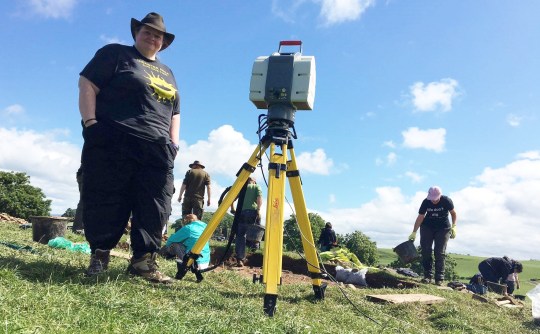
Several months ago we reported on a major archæological dig attended by the School’s Dr Nik Whitehead, Associate Professor.

The excavation was working on an important Bronze Age site at a secret location in Lancashire, and Dr Nik was fortunate to be present when a beautiful funerary urn was discovered.

The micro-excavation of the artefact turned out to be a delicate, challenging and nerve-wracking process.

“It was amazing watching the urn being uncovered layer by layer, and seeing more and more detail as everyone realised how big it was,” she says.  “It was definitely the hot topic of coffee break conversations!”

Below, Dr Nik shares her photographs of the exciting moment the urn finally emerged from its long hiding-place underground.

The urn was taken to a laboratory, where osteoarchæologist Sam Walsh has been painstakingly examining every fragment.  Her initial findings are nearly ready, and DigVentures, who sponsored the dig, will be sharing them shortly.

Follow the dig, and find out more about DigVentures here :

http://us4.campaign-archive2.com/?u=22a0f4e4c7f72ba483492ac1b&id=c692022072&e=d3e2324822


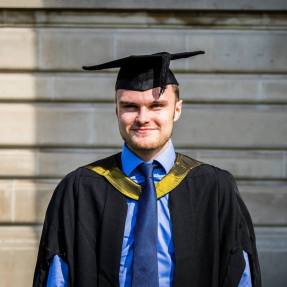
Aidan Kiely was one of our first graduates from the MEng Environmental Engineering programme in 2016. He started his studies on BEng Computer Systems and Electronics programme and then progressed to the MEng. He’s been telling us what he’s doing now.
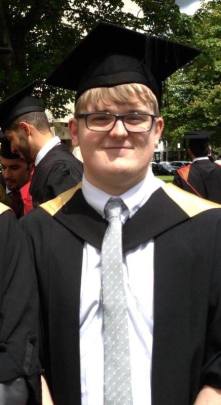
aidan-graduation

Q. What is your Name?
Aidan Kiely

Q. What was your University course?
MEng Computer Systems and Electronics (Applied Environmental Engineering)

Q. What is your job title and role?
Water Network Mapping Analyst – my role involves analysing the current Welsh Water water distribution network to find specific points of interest for ongoing water conservation and leakage projects.

Q. Could you briefly describe the organisation you work for?
Aqualogic (wc) is a water conservation company that are focused on helping customers to save water with various products and services. The current role that I’m working in is partnership with Welsh Water in helping them with similar issues on a national scale.

Q. Which skills learned at University are helpful to you in your job?
A lot of my work is office based and I use a lot of the IT skills I developed during my time at university, especially MS Office packages. Some of the information I learnt on water treatment crops up occasionally but not often as I’m in distribution as opposed to treatment. Working with others within a team and my ability to work independently are also used every day.

Q. Do you have a typical day and how would you describe it?
A typical day starts with co-ordinating with sub-contractors working on the same project as our company. I’ll then go back to analysing the water network for the points of interest based on the criteria set by Welsh Water and also processing some jobs to prepare for construction. I’ll rotate through these tasks and attend to any issues raised by Welsh Water or any of the sub contractors if I’m able to help.

Q. What aspects of your job do you enjoy most?
Working with a varied group of companies based in water distribution, construction, planning and maintenance is very interesting. When I was applying for work, it always felt like I’d be left to my own devices but a lot of the work is done as a team and collaborating with co-workers is always a rewarding experience.

Q. Do you have any advice for students who would like to start a Career?
Always try to keep a positive outlook as it’s easy to get disheartened when things don’t go how you planned. And apply, apply, apply! Use all of the available job search apps and services as many of them are very helpful. Also keep an eye out for any graduate programs that some companies run, these can be a great head start for your career!


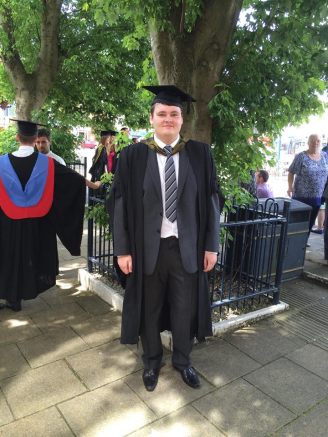
Nathan Munkley has been telling us what he’s been doing since Graduation. Nice to hear from you, Nathan.

nathan

Q. What is your Name?

Nathan Munkley

Q. What was your University course?

BSc Computer Networks

Q. What is your job title and role?

FRT Engineer

Q. Could you briefly describe the organisation you work for?

Rock IT is an expanding Managed Service Provider based in South Wales, Rated top 10 IT Support Organisations in the UK.

Q. Which skills learned at University are helpful to you in your job?

Everything learnt at university has been extremely useful in provided the knowledge I need to do my job on a daily basis. The Networking modules have been the most useful and the ability to complete CCNA by the end of it is very good to have on CV.

Q. Do you have a typical day and how would you describe it?

Each day is different and brings new challenges. At FRT Level each engineer gets 40 minutes to work on a ticket, this could be anything from a simple account change to a full scale infrastructure down. RockIT trust engineers with any issue that comes in. Being able to use all range of skills across various issues is what makes the job interesting.

Q. What aspects of your job do you enjoy most?

I enjoy the huge variety of challenges I face on a daily basis which enables me to continuously develop my skills.

Q. Do you have any advice for students who would like to start a career?

Continue to study and learn, IT is changing at a rapid pace and to be able to keep up with the industry don’t be afraid to learn even more. University is just the start of great things.

2-b4-ceremony-138
Q. What is your Name? Adam Davies
 
Q. What was your University course? BSc Computer Networks
 
Q. What is your job title and role? Infrastructure Engineer. This involves managing a virtual infrastructure built on VMWare vSphere along with managing the SAN, backups, operating systems and servers
  
Q. Could you briefly describe the organisation you work for? CGI, a Canadian company which operates out of 40 countries with 68,000 employees.
   
Q. Which skills learned at University are helpful to you in your job? The most useful skills I learnt at University were from the module based on network design. It got me to think of the bigger picture and how each component affects the other. This has been useful when implementing new services into the existing virtual infrastructure that I manage.
  
Q. Do you have a typical day and how would you describe it? The best thing about my job is that there isn’t a typical day; I could be swapping out a failed hard drive or troubleshooting a virtual machine one day or adding new components to the infrastructure the next day.
  
Q. What aspects of your job do you enjoy most? The thing I enjoy most about my job is when something goes wrong. This is where your skills are really put to the test and you always end up learning something new.
  
Q. Do you have any advice for students who would like to start a Career? The best advice I could give current students is to stay up to date with the IT industry. It’s ever evolving so in order to make an impact you really need to know what’s going on in the industry. Get in to the habit of reading articles as this will help you identify what’s up and coming and what your employer can use to improve its offerings to its customers.

The SOAC staff have been supporting Save the Children’s Christmas Jumper Day today. Here are a few of them looking festive:

The Applied Computing Team would like to wish all our Students, Graduates and Partners a Very Merry Christmas and a Happy New Year – Enjoy the Holidays Everyone

christmas-trees

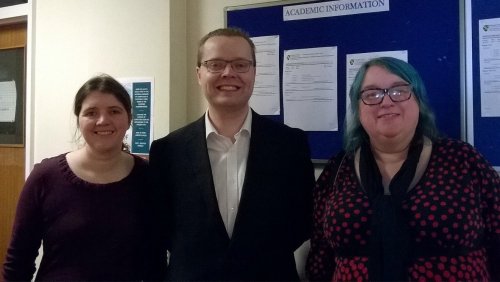
We were happy to see Aiden Herbert, graduate of BSc Software Engineering (and MSc Applied Computing 2015), again yesterday. Aiden came back to talk to our current students about life after University. Aiden is now working as a software engineering in Cheltenham.

Here he is with staff members Gaynor and Sue.

aidan

Our Faculty Research Seminar for December was held today.

Luca Pagano (Senior Research Engineer) spoke on “Non Destructive Testing” and ways to detect damage in composite materials, using applications such as aircraft wings, without the need to disassemble them.

Mr. Andrew Smith (Senior Lecturer, Open University) gave a talk on “Teaching with Twitter” – including teaching via many other social media outlets. Many colleagues from other Faculties (eg Education) also joined us today to hear his talk. Check him out on @OUCisco or @teraknor on Twitter.

Many thanks to both our speakers, very different subjects, but both very interesting talks.We will be posting the slides from these talks on Moodle soon in case you missed them!


As part of our Green Impact, we held another of our occasional lunchtime walks today. It was a lovely day and unseasonably warm (well, for December!) Taking part were staff members Sue Maw, Carlene Campbell and Gaynor Thomas, and Software Engineering Year 1 student Rory and Jonathan.

We walked up the hill from campus to the Mayhill Wildlife Corridor which has fantastic view over Swansea Bay, and less than a 10 minute walk from campus.

rob

Q. What is your Name? Robert Lewis

Q. What was your University course? BSc. Computer Networks

Q. What is your job title and role? Network Engineer

Q. Could you briefly describe the organisation you work for? SA1 Solutions – Providing server and network support for customers.

Q. Which skills learned at University are helpful to you in your job? Cisco qualifications which have proved incredibly useful in my line of work. A very good understanding of Network infrastructure and network security. Confidence in speaking to a group of people and clearly explaining your thoughts and views on something.

Q. Do you have a typical day and how would you describe it? One of the best things for working for my current employer is that there is no ‘Typical day at work’. Each day presents me with a new challenge whether it be a networking issue, a server issue or a telecommunications issue. In my capacity as Network Engineer, it is my duty to identify and resolve any issues within a timely manner. Other days consist of project work whether it be building phone systems in CentOS through the use of FreePBX or working on current network management systems.

Q. What aspects of your job do you enjoy most? Ability to work hands on with the latest equipment and the feeling of working as a part of a team.

Q. Do you have any advice for students who would like to start a Career? No one will go into a career knowing absolutely everything and that’s not a bad thing. The whole process is a learning curve and you will never stop learning, especially in the technology field as it progresses so quickly. You must always be confident in your own abilities. Finally, if you ever get an opportunity to do something that interests you, take it with both hands.