Bringing Plato’s Cave to Life with Immersive Technology
Bringing Plato’s Cave to Life: UWTSD Students Transform Ancient Philosophy Through Immersive Technology
How do you teach a 2,400-year-old philosophical thought experiment to a generation raised on digital technology?
At the University of Wales Trinity Saint David (UWTSD), the answer has been to step beyond the traditional classroom and into an immersive digital world.
A team of Games Design students has developed an innovative interactive recreation of Plato’s Cave, one of philosophy’s most famous and enduring thought experiments. The project brings together expertise from philosophy, games design, applied computing, and immersive technologies to create a learning experience that allows students to explore philosophical ideas in a completely new way.
Reimagining a Timeless Philosophical Concept:
Plato’s Allegory of the Cave has been used for centuries to explore questions about reality, perception, knowledge, and truth. Traditionally encountered through textbooks and classroom discussion, the allegory challenges learners to consider how much of what they perceive is genuine reality and how much may simply be a shadow of something deeper.
| Summary: Plato’s Allegory of the Cave |
| Plato’s Allegory of the Cave is a powerful philosophical story about the difference between appearance and reality. In the allegory, prisoners spend their lives chained inside a cave, seeing only shadows on a wall and believing those shadows to be the whole of reality. When one prisoner escapes and discovers the world outside, he realises that what he once accepted as truth was only a limited representation of a much greater reality. The allegory is often understood as a metaphor for education and personal growth. Plato suggests that true learning is not simply about acquiring information, but about transforming the way we see the world. It encourages us to question assumptions, challenge accepted beliefs, and seek a deeper understanding of truth rather than accepting appearances at face value. On a deeper level, the allegory can also be viewed as a journey of awakening. The cave represents limited awareness, the shadows symbolise misconceptions and conditioned beliefs, and the journey into the light represents the pursuit of wisdom, knowledge, and greater consciousness. Its enduring message is that growth begins when we are willing to move beyond the familiar and explore a fuller understanding of reality. |
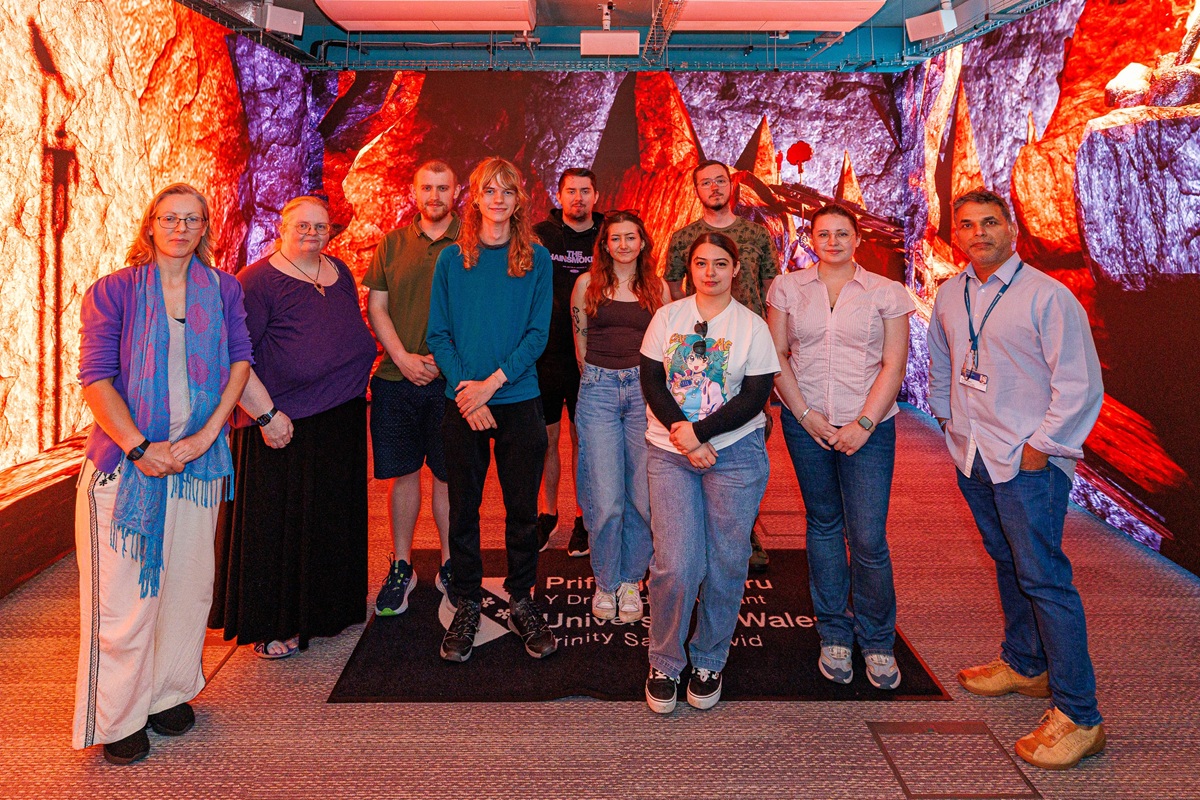
Now, UWTSD students have transformed this ancient philosophical narrative into a fully immersive digital experience within the University’s Interactive Room at Y Fforwm in Swansea. Working with academic staff from the School of Applied Computing, seven Games Design students recreated Plato’s Cave using professional game development technologies and production techniques.
A Truly Interdisciplinary Project:
One of the most exciting aspects of the project is its collaborative and interdisciplinary nature. Students took on specialist industry-style roles including:
- 3D Modelling
- Animation
- Sound Design
- Texturing
- Lighting
- Unreal Engine Development
By mirroring professional creative industry workflows, the project provided students with valuable real-world experience while contributing to an innovative educational resource for the University. The initiative demonstrates how authentic learning experiences can simultaneously support student professional development and enhance teaching and learning across disciplines.
Technology Enhancing Learning:
While the project is rooted in philosophy, its impact reaches much further. The immersive experience has been designed not only for philosophy teaching but also for subjects such as media studies, semiotics, digital humanities, art, and creative technologies. The resource offers educators an engaging way of exploring abstract concepts through experiential learning, enabling students to move beyond passive observation and actively engage with complex ideas.
Importantly, the experience is available in both Welsh and English, making it one of the first immersive philosophy teaching resources of its kind to offer bilingual delivery. This reflects UWTSD’s commitment to accessibility, inclusivity, and innovation in education.
Student Learning Beyond the Classroom:
The project formed part of a student internship initiative, giving participants the opportunity to work on a genuine educational brief with a lasting impact. Beyond developing technical expertise, students strengthened key employability skills including:
- Teamwork
- Communication
- Creative problem solving
- Project management
- Cross-disciplinary collaboration
Student participant Joshua Platt highlighted how the experience enabled the team to combine technology, creativity, and education while developing valuable professional capabilities for their future careers.
Professor Nik Whitehead emphasised the significance of bringing together philosophy, games design, and immersive technology to create an educational experience that reaches broader audiences, with the bilingual approach helping to maximise accessibility.
The Future of Immersive Education:
Projects such as this highlight the growing potential of immersive technologies in education. Rather than simply reading about concepts, learners can increasingly experience them, creating deeper engagement and understanding.
The Plato’s Cave project represents more than a technological achievement. It demonstrates how universities can blend Humanities and Digital Technologies to create powerful learning experiences that prepare students for future careers while enriching the educational experience for others.
As higher education continues to explore new approaches to teaching and learning, UWTSD’s immersive interpretation of Plato’s Cave provides an inspiring example of how ancient ideas can find new life through modern technology.
The shadows on the cave wall may be ancient, but the future of learning is anything but.
To learn more about UWTSDs Computing courses please click-here.



 UWTSD Applied Computing Blog