Turn On Your Future @ UWTSD's School of Applied Computing & Electronics

Author Archive

Faculty Lunchtime Research Seminar April 2017 (report)

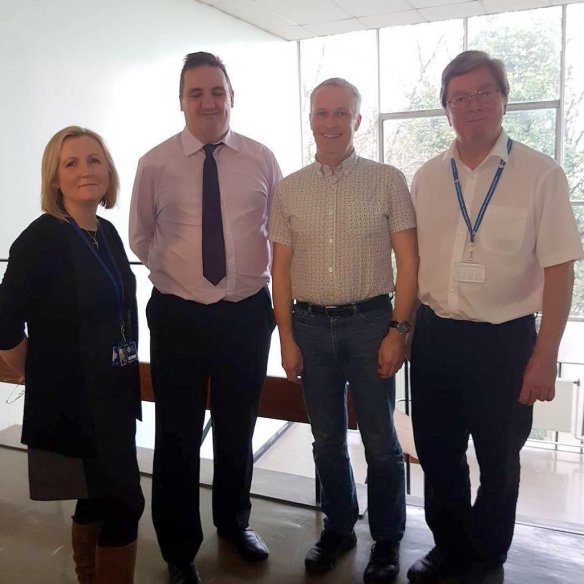
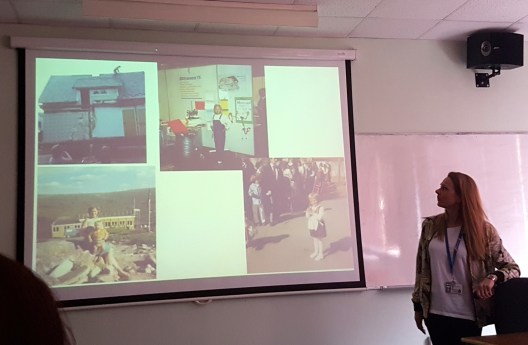
  •  Mr. Arya Sedigh PhD student From School of Applied Computing, Computer Networks & Communications Research Group. His talk was  on a non-intrusive method to evaluate and monitor the performance of voice communications over Long Term Evolution (LTE) networks.
    Arya

    Thank you to Tyra and Arya for their very interesting talks today. The slides will shortly be available on Moodle under “Faculty Lunchtime Research Seminars” – contact computing@uwtsd.ac.uk if you are unable to access them.

Gower College Taster Day

Gower College students have been with us today for a taster day in various aspects of the courses we run. Today they have been learning about networking, ethical hacking and games design (algorithms and Unity).

Here are some pictures of the student in action:

NHS Wales Masterclass (IT Service Management)

We’ve had a Masterclass today with Keith Reeves from NHS about how IT Services are managed within the NHS. This is a big challenge given the size and scope of the organisation, with over 72,000 staff, 7 Health Boards and 3 Trusts, and 442 GP Practices. The NHS use the ITIL framework. The slides will be uploaded to Moodle (Faculty Lunchtime Research Seminars) shortly.

s1

s2

Faculty Lunchtime Research Seminar, March 2017 (report)

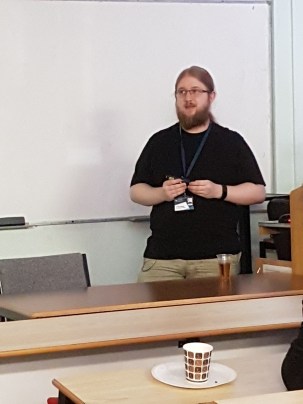
One of the School’s PhD students, Archie Watt, featured in the monthly Faculty Lunchtime Research Seminar yesterday. He was presenting his work on Monitoring Coastal Erosion, a continuation of the ASTEC project undertaken in the school a few years ago. An array of wireless sensors will return data on a regular basis to monitor changes in the coast. Coastal erosion is a hot topic for the UK, with several high-profile collapses in the last few years.

20170315_142435

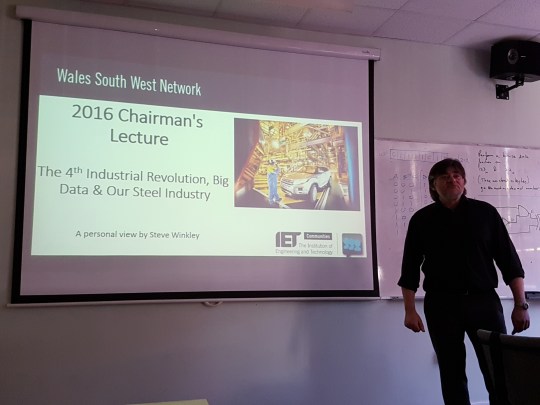
We also had a talk from Mr Steve Winkley of Tata Steel who told us about ways in which Tata Steel, and industry in general, are hoping to modernise with reference to Big Data and other technological developments.

The slides from both talks are available on Moodle under “Faculty Lunchtime Research Seminars” for anyone who missed it, or wants to have another look. Thank you, Archie and Steve!

20170315_132104

20170315_141707

2017 Trip to the National Museum of Computing

On March 10th 2017, we made our second departmental visit to the National Museum of Computing. It was an early start from Swansea to get to Milton Keynes by 10.30am.

At The National Museum of Computing, we had some introductory talks with an overview of old tech that some of us remembered better than others!

Then we were off for a tour of the facilities. Here we are looking at the Harwell Dekatron Computer (later renamed the WITCH). This is the oldest surviving computer in existence (as opposed to a replica) dating from 1947.

We also saw the famous Colossus machine, which was able to find the keys for ciphers during the Second World War. It remained top secret until the 1970s.

We had a tour of more relatively recent tech – here’s some computers from the 1970s and the 1980s with the Apple Lisa at the top:

Who can resist a bit of retro gaming?

After lunch, we used the BBC Micro computer lab (1980s) to do a bit of programming in BASIC – a snake game:

And finally an attempt to get a computer to pass the Turing Test by entering friendly phrases for a computer to produce in answers to questions posed to it:

We all had a great day out and learnt a lot about the history of Computing which has come so far in such a relatively short time. Thank you so much to everyone at The National Museum of Computing and thank you Carlene for organising the trip!


Daniel Hawkes (Alumnus) Masterclass – Big Data and Business Intelligence

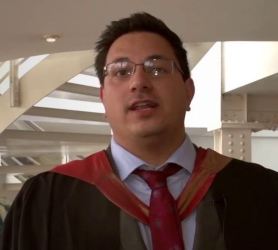
The School of Applied Computing were pleased to welcome back Graduate Daniel Hawkes this lunchtime to give a Masterclass for undergraduate students on the challenges facing change and data management. Daniel studied the Business Information Technology degree as a part time student whilst he was also working and graduated from UWTSD in 2016. He is now a Complex Analysis Manager for BT, looking at big data and business intelligence.

Daniel said: “I was already doing a technical role within BT but I needed more business knowledge and theory. BSc Business Information Technology helps you from a corporate perspective because it has a nice balance between data and business. I would not be here without doing both the degree and my job. They went hand-in-hand. The degree sets you up for the future because it gives you a rounded understanding of how businesses operate. The lecturers at the School of Applied Computing are fantastic – I would recommend the course, the university, everything.”

Alumni News: Sam Derby (BEng Computer Systems and Electronics) – working for McAfee

sam

Sam Derby, who graduated in 2014, has been telling us what he’s doing these days while working for McAfee.

Q. What is your Name?
Samuel Derby

Q. What was your University course?
BEng(Hons) Computer Systems and Electronics

Q. What is your job title and role?
Software Quality Engineer at Intel Security (McAfee). My role splits between two main distinctions: Projects and Operations. Operations are helping build and test our daily antivirus releases (DAT). Projects are varied, but usually have the end goal of making our product releases more efficient and our testing more effective.

Q. Could you briefly describe the organisation you work for?
Intel Security (McAfee) is one of the World-leading antivirus software developers. We create solutions for software and technical security against malware, ransomware and other emerging digital threats. Originally housed within Intel, McAfee, is a 7500 strong team across the World.

Q. Which skills learned at University are helpful to you in your job?
I do a lot a bug fixes and troubleshooting, although the code languages I learnt in University were different, the methodical and systematic approach to code debugging I was taught, are applicable to any language and I still use those methods today.
Also, and surprisingly to me, giving presentations at University helped a lot. At work, we regularly host demos of code changes, new products and testing methods. Proposing these changes to a very skilled team can be daunting, but I’m far more confident doing it now having been grilled by lecturers in Q&A sessions.

Q. Do you have a typical day and how would you describe it?
Project Days are standard 9-5 and usually start with a 10-15mins project sync stand up. Everyone in the team says what they did yesterday, what they are doing today and if they are on target for deadlines. The day will be mixed then between meetings and code/software development. Any changes that are proposed have a rigorous testing cycle and approval process. This means creating test plans and release criteria and completion dates. Along with submitting Requests for Change to our Chance Advisory Board.
Operations shifts are 1 day a week and 1 weekend a month. This requires starting at 6am and finishing at 2pm, to better align with our team in India and meaning the antivirus update can go out to customers earlier.

Q. What aspects of your job do you enjoy most?
I enjoy the challenge and the variety. To say every day is different would be inaccurate, but the projects you work on are never the same. This means learning myriad processes and numerous coding languages. Also, this job offers a level of respect I’ve not experienced in any other company. Constantly you are asked for your opinion and it is considered on any change that affects the team, regardless of your position or seniority.

Q. Do you have any advice for students who would like to start a career?
Don’t add things to the CV that make you out to be the perfect candidate, because no one is. If you’re under qualified for the role, accept it and look for another job. Go for roles that offer challenge, but are still inside your remit and skills and you’ll make a much stronger first impression.

Q. A Quote that sums up your time at the University?
“You’re lucky you’re good at presentations, ‘cos you’re not too good at Electronics!”

Brilliant! Still makes me laugh to this day, and he was right, I was awful at Electronics. I’ve still got the burns marks from soldering irons to prove it(!)
Alumni news: Mr Chandan Jayanna (MSc Computer Networks)

Chandan Jayanna was an international student on our MSc Computer Networks programme a few years back. He’s been telling us what he’s doing now (see below). Nice to hear you are you enjoying your career, Chandan!

1

Q. What is your Name? Mr. Chandan Jayanna

Q. What was your University course? MSc in Computer Networks

Q. What is your job title and role? Senior Network Lead.

Q. Could you briefly describe the organisation you work for? I work for Hinduja Global Solutions (HGS). It’s a multinational company which provides a full suite of business process management (BPM) services from traditional voice contact center services and transformational DigiCX services that are unifying customer engagement to platform-based, back-office services and digital marketing solutions.

Q. Which skills learned at University are helpful to you in your job? The skills gained through the university were the theoretical and practical experience on the in-depth LAN and WAN network establishment from design to maintenance. There was added advantage of having access to CISCO NetAcad program as part of the course which gave us insight about the practical network issues and ideas how to troubleshoot them.

Q. Do you have a typical day and how would you describe it? As a Sr. Network Lead I am responsible for planning, setting up and maintaining of BPO and corporate network. Research and Provide networking solutions around projects related to voice, video and data network. Designing, Implementing and Troubleshooting Data Center Networking solutions. Provide guidance on escalated operational issues involving routers, switches, load balancers, wan optimizers, and firewalls in a multi routing infrastructure. Balancing Project responsibilities with escalated operational Issues. Prepare and maintain up to date documentation detailing assigned/ deployed solution, evaluate, enhance, deploy and manage Network Tools infrastructure to deliver KPIs to manage network services. Providing technical support/troubleshooting for day-to- day operation to users on LAN and standalones Machines.

Q. What aspects of your job do you enjoy most? I enjoy every part of what I do as I get to learn new things every day. The challenges that I face in troubleshooting the issues are the most interesting part of my job.

Q. Do you have any advice for students who would like to start a Career? Always listen to your instincts and never hesitate to take up challenges as they make us strong and confident in life. Never give up on your passion and find ways to achieve it. Sacrifice today for a better tomorrow.

We always love to hear from our alumni, drop us a line on computing@uwtsd.ac.uk any time!

Faculty Lunchtime Research Seminar (January 2017)

Tim Bashford and Jaymie Phillips were our first speakers of the year in our Faculty Lunchtime Research Seminar today. There was a distinctly Computing flavour this month. Tim told us about his work optimising an algorithm and code for processing data concerning the effect of lasers on skin. Jaymie then told us about his work on coding for embedded systems.

Tim has recently completed his PhD, and Jaymie is in the second year of his PhD studies. Thank you very much for your presentations. Here are some photos of them in action!

2017-01-18-13-35-24  2017-01-18-13-44-39

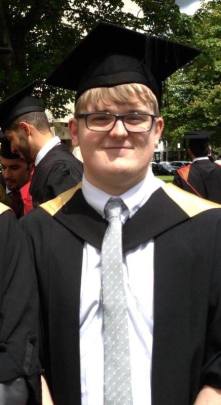
Graduate Profile: Aidan Kiely (MEng Environmental Engineering)

Aidan Kiely was one of our first graduates from the MEng Environmental Engineering programme in 2016. He started his studies on BEng Computer Systems and Electronics programme and then progressed to the MEng. He’s been telling us what he’s doing now.

aidan-graduation

Q. What is your Name?
Aidan Kiely

Q. What was your University course?
MEng Computer Systems and Electronics (Applied Environmental Engineering)

Q. What is your job title and role?
Water Network Mapping Analyst – my role involves analysing the current Welsh Water water distribution network to find specific points of interest for ongoing water conservation and leakage projects.

Q. Could you briefly describe the organisation you work for?
Aqualogic (wc) is a water conservation company that are focused on helping customers to save water with various products and services. The current role that I’m working in is partnership with Welsh Water in helping them with similar issues on a national scale.

Q. Which skills learned at University are helpful to you in your job?
A lot of my work is office based and I use a lot of the IT skills I developed during my time at university, especially MS Office packages. Some of the information I learnt on water treatment crops up occasionally but not often as I’m in distribution as opposed to treatment. Working with others within a team and my ability to work independently are also used every day.

Q. Do you have a typical day and how would you describe it?
A typical day starts with co-ordinating with sub-contractors working on the same project as our company. I’ll then go back to analysing the water network for the points of interest based on the criteria set by Welsh Water and also processing some jobs to prepare for construction. I’ll rotate through these tasks and attend to any issues raised by Welsh Water or any of the sub contractors if I’m able to help.

Q. What aspects of your job do you enjoy most?
Working with a varied group of companies based in water distribution, construction, planning and maintenance is very interesting. When I was applying for work, it always felt like I’d be left to my own devices but a lot of the work is done as a team and collaborating with co-workers is always a rewarding experience.

Q. Do you have any advice for students who would like to start a Career?
Always try to keep a positive outlook as it’s easy to get disheartened when things don’t go how you planned. And apply, apply, apply! Use all of the available job search apps and services as many of them are very helpful. Also keep an eye out for any graduate programs that some companies run, these can be a great head start for your career!