
Name: Ze Wu
Q. Course: MSc Software Engineering and Artificial Intelligence
Q. Project title: Detection of fusarium head blight on wheat spikelets using a multi-scale feature fusion CNN model.
Q. Introduction/rationale: The motivation for choosing this project stems from the significant impact of fusarium head blight (FHB) on wheat production, which poses a threat to global food security. By leveraging advanced artificial intelligence techniques, this project aims to develop a robust detection system that can assist farmers in early identification of FHB, ultimately contributing to better crop management and yield optimization.
Q. Overview of the practical implementation:
- Data Collection: Acquiring a dataset of wheat spikelet images, both healthy and affected by FHB.
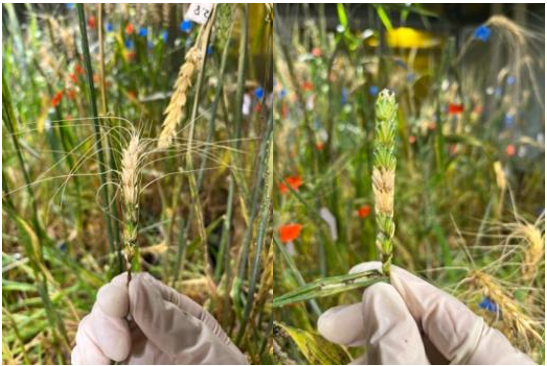
Figure 1: Dataset Samples
- Model Development: Designing a multi-scale feature fusion convolutional neural network (CNN) to analyze the images. Built on the advanced YOLOv9 framework, the model incorporates a Multi-Scale Feature Enhancement and Fusion (MSFEF) module, which plays a critical role in extracting and dynamically enhancing features from various scales. To enhance computational efficiency, as shown in Figure 2, optimized convolutional layers such as RepNCSPELAN and DWConv are used, reducing the overall computational load while maintaining high detection performance.

Figure 2: Proposed network overview
- Training and Testing: The model was trained on the dataset using techniques like data augmentation (Mosaic) to enhance its robustness. Testing was conducted to evaluate accuracy and performance.

Figure 3: Training batch samples
- Deployment: The final model can be integrated into a user-friendly application for real-time detection, offering researchers and farmers an efficient tool for early disease detection and management.
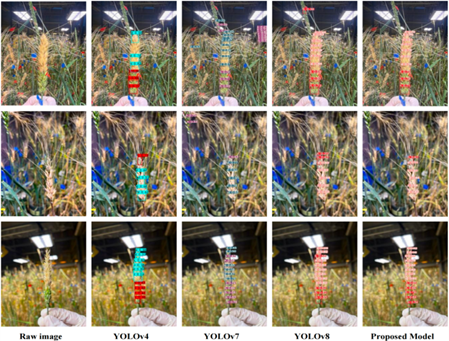
Figure 4: Model predictions
Q. Overview of outcome/conclusion:
The project successfully demonstrated that the proposed multi-scale feature fusion CNN model can accurately detect fusarium head blight in wheat spikelets, achieving an accuracy of over 90%, which highlights the potential of AI-driven solutions in agriculture, paving the way for future advancements in plant disease management and crop monitoring.
Q. What Career and job role are you hoping to move into after graduation?
After graduation, I aspire to work as a machine learning engineer, focusing on applying AI in agricultural technology. My goal is to contribute to innovations that enhance food security and sustainability through smart farming practices.
Q. Please share a top tip/advice for students who are interested in completing a University Degree?
One essential piece of advice is to stay curious and actively engage with your coursework beyond the classroom. Seek out projects, internships, and collaborative opportunities that apply your knowledge in real-world contexts. Building a strong network and gaining practical experience will significantly enhance learning and career prospects.
For further information about Computing courses at UWTSD, please click-here.

 UWTSD Applied Computing Blog
Written by jameswilliams
Leave a comment