Project profile: Tyler Williamson

Name: Tyler Williamson
Course: BSc (Hons) Data and Information Systems (Degree Apprenticeship – Applied Data Science Stream)
Project Title: A Holistic Neurodiversity Framework and AI Driven Dashboard for Neurodivergent Students
What was the reason / motivation for choosing the project: This project was driven directly by my lived experience as a neurodivergent individual (Autism/ADHD). Navigating education and the transition into adult life, I experienced first-hand the strong disconnect between traditional support systems and the reality of neurodivergent conditions. Support is too often treated as a rigid, one-size-fits-all tick-box exercise, but that is simply not how neurodiversity works, everyone’s sensory triggers, executive function, and daily challenges are unique and can fluctuate day to day.
When you are already experiencing burnout or executive dysfunction, having to repeatedly ask for help or navigate complex administrative forms creates a massive barrier. I wanted to build a personalised, low-demand technical solution that bridges the post-16 support “cliff-edge”, shifts the focus away from trying to “fix” the individual, and provides authentic insight into removing real-world environmental barriers, moving from reactive to proactive support.
There is enormous potential for modern technology to bridge this gap. The real question is how we advance data infrastructure and usability to create proactive, modular solutions that can adapt and evolve over time to genuinely support people.
Brief overview of the practical implementation:
Following Peffers’ Design Science Research Methodology (DSRM), I engineered a proof-of-concept four-tier cloud and database platform:
- Front-End Interface (Tier 1)
- Integration and AI Layer (Tier 2)
- Hybrid Security Layer (Tier 3)
- Data Persistence and Analytics (Tier 4)
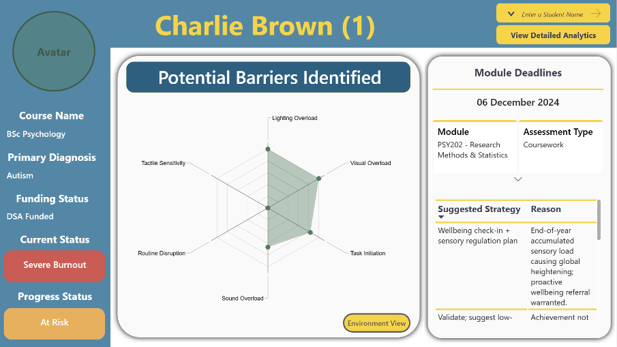
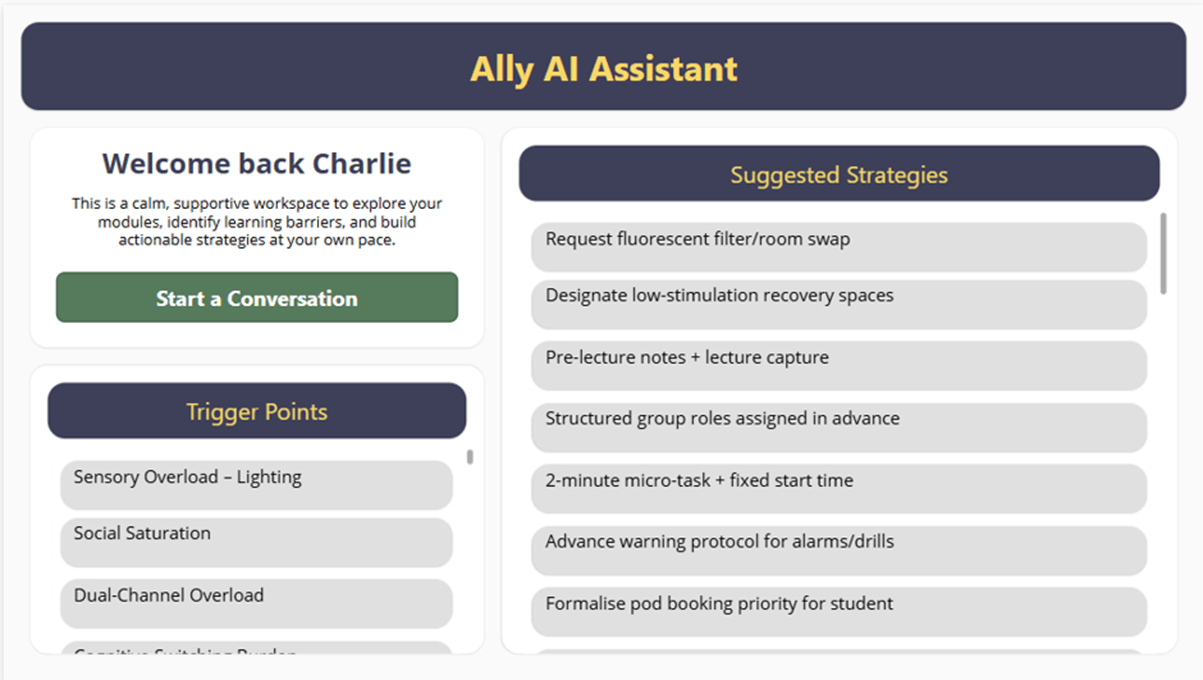
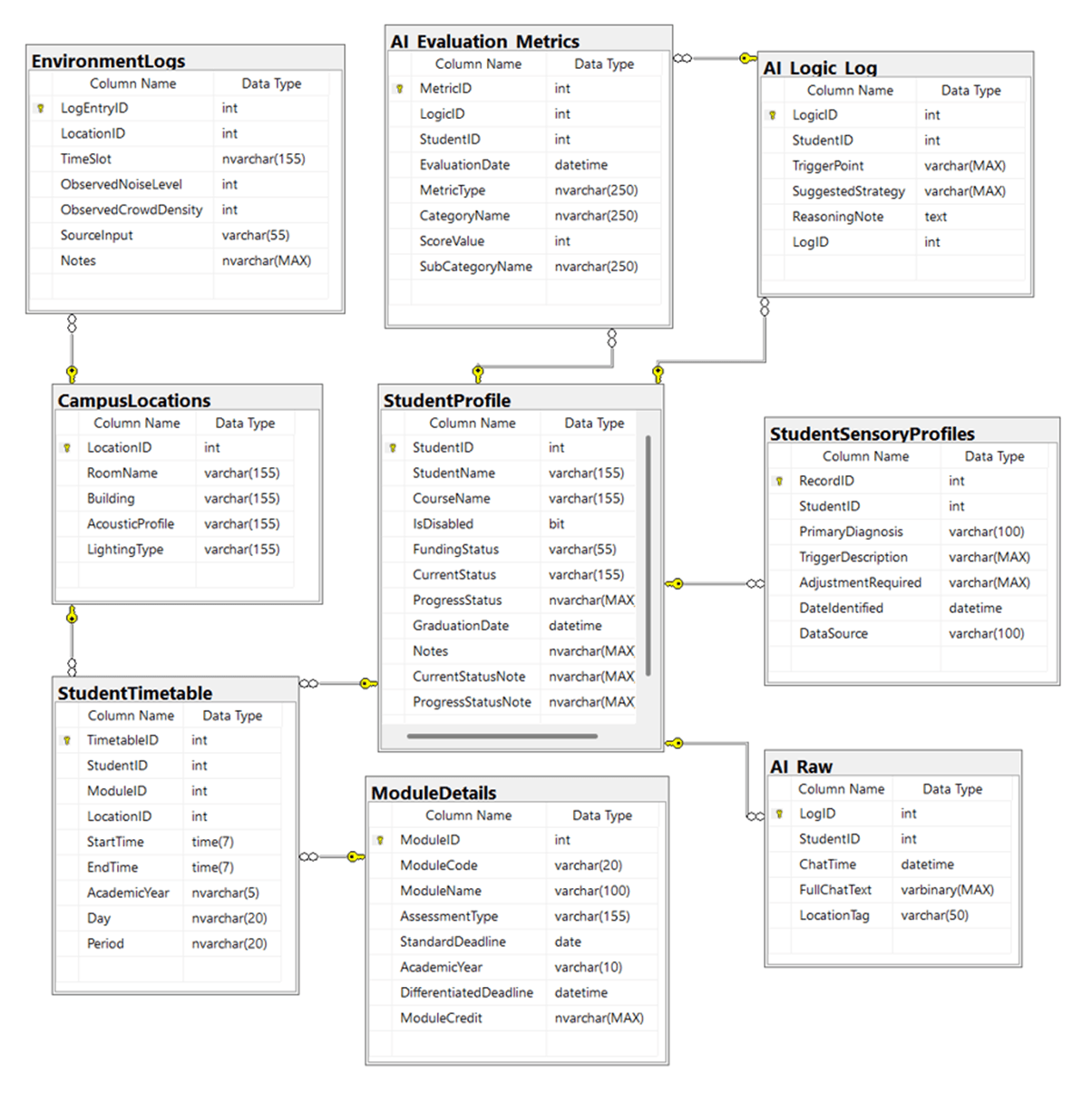
The implementation of each layer is briefly described and illustrated below:
- Front-End Interface (Tier 1): Built an accessible Power Apps Canvas App (Ally) strictly evaluated against WCAG 2.1 AA guidelines, providing 24/7 low-demand micro-step coping strategies for task initiation and emotional regulation without sensory overload.
- Integration and AI Layer (Tier 2): Configured automated Power Automate cloud flows to process structured intervention logic, trigger generative AI prompts, and categorise barrier telemetry.
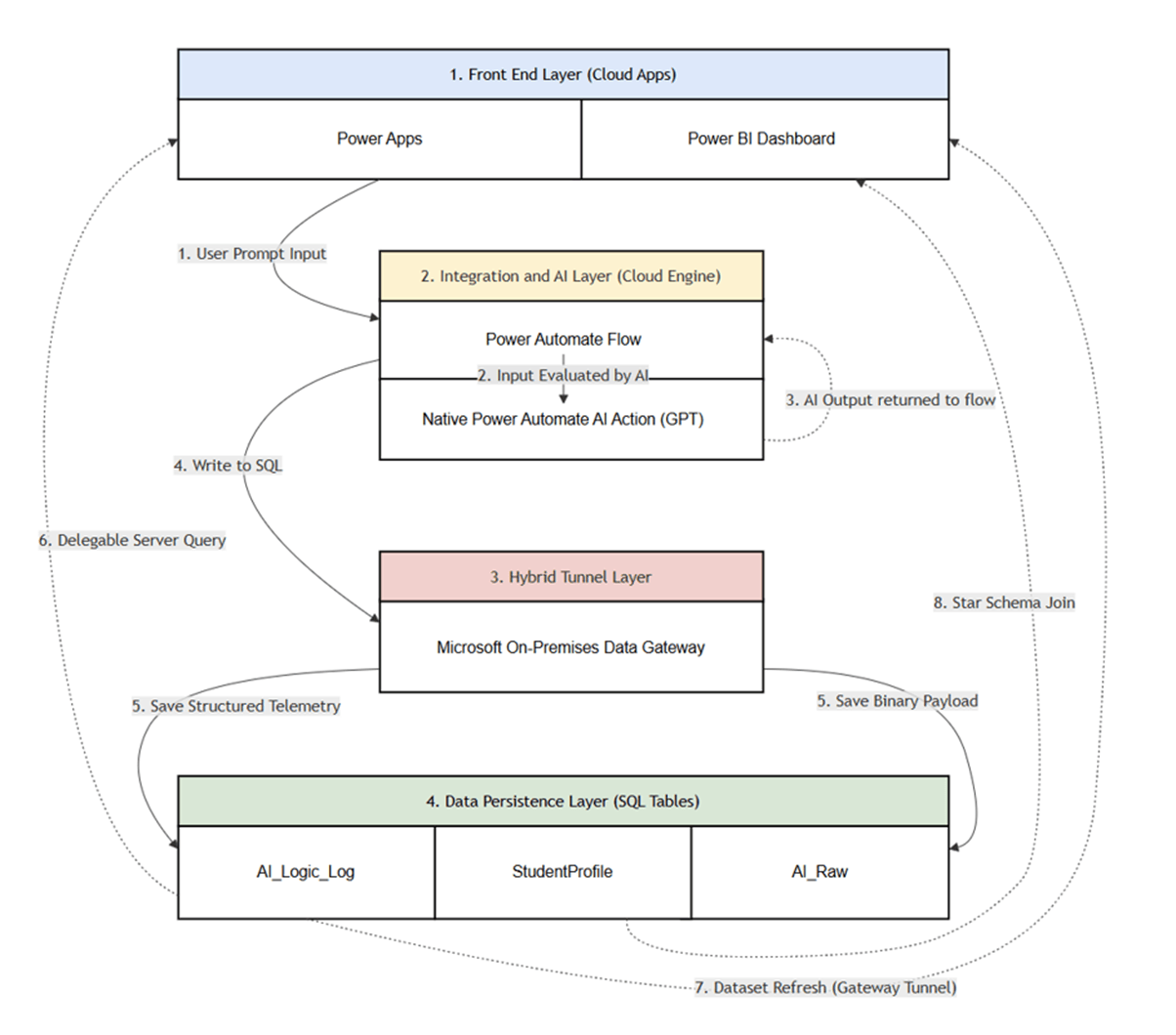
- Hybrid Security Layer (Tier 3): Deployed a Microsoft On-Premises Data Gateway establishing an outbound-only HTTPS reverse-proxy tunnel to securely communicate with backend infrastructure without opening public firewall ports.
- Data Persistence and Analytics (Tier 4): Designed a relational SQL Server database enforcing Privacy-by-Design by storing binary-encoded raw chat logs decoupled from aggregate barrier metrics. An executive Power BI suite visualises these barrier radar trends for support teams while keeping personal student narratives completely anonymous.
Overview of the outcome / conclusion: The platform demonstrated that enterprise low-code tools, combined with robust relational database engineering and privacy-first design, can effectively mitigate cognitive overload. Through the empirical evaluation of this project it yielded an 80% pass rate for functional stability, an average stakeholder concept rating of 4.82/5.00, and 90.9% agreement that the system fosters autonomous self-advocacy without creating digital dependency. The final project and viva itself were notably described as “potentially socially ground-breaking.” Looking ahead, the long-term vision is to scale this framework beyond higher education into workplaces and healthcare systems as a preventative mental health tool, gathering real lived-experience telemetry to proactively adapt physical and digital environments. Future work also includes integrating W3C Verifiable Credentials to create a lifelong, portable “support passport” that individuals can carry between education, employment, and health services without having to repeatedly re-prove their difficulties or relive past challenges.
Top tip/advice for students: Completing a university degree has been both challenging and deeply rewarding. The feeling of finishing each module never failed to make me smile. On my first day, I felt like a deer in headlights, I had no idea how to write an academic paper, didn’t understand referencing, and having been out of education for 10 years, I genuinely felt out of my league. That couldn’t have been further from the truth; I did far better than I ever expected and surprised even myself. I am so proud to have completed the programme and learned so much about my own capabilities as well as learned a whole new set of skills.
My advice is to choose a project that you have a genuine passion for, rather than just picking a generic brief that is already existing. When you solve a real, meaningful challenge, navigating technical roadblocks, complex architecture, and rigorous academic research becomes far more engaging and rewarding. Focus on your primary goal early: identify what your friction points are from day one of your course and use that insight to innovate and develop a purposeful project you will be proud of for years to come. Be transparent about your project’s constraints and trade-offs, academic rigour is about critical self-awareness and solid engineering principles, not absolute perfection of execution. It is about the ability to reflect honestly on shortcomings and demonstrate how to overcome them in future work.
A great bit of advice is this: “Deadlines measure time, but momentum defines progress. If you can do it today, don’t leave it to tomorrow.”
This mindset influences my approach to both my studies and my professional work.
Don’t hold back from pursuing a bold idea. Pick a degree subject that truly interests you, find and create a project you can sink your teeth into, and build something that truly matters to you.
~
Da iawn Tyler!
For more information about Computing courses at UWTSD please click here or email: Computing@uwtsd.ac.uk